
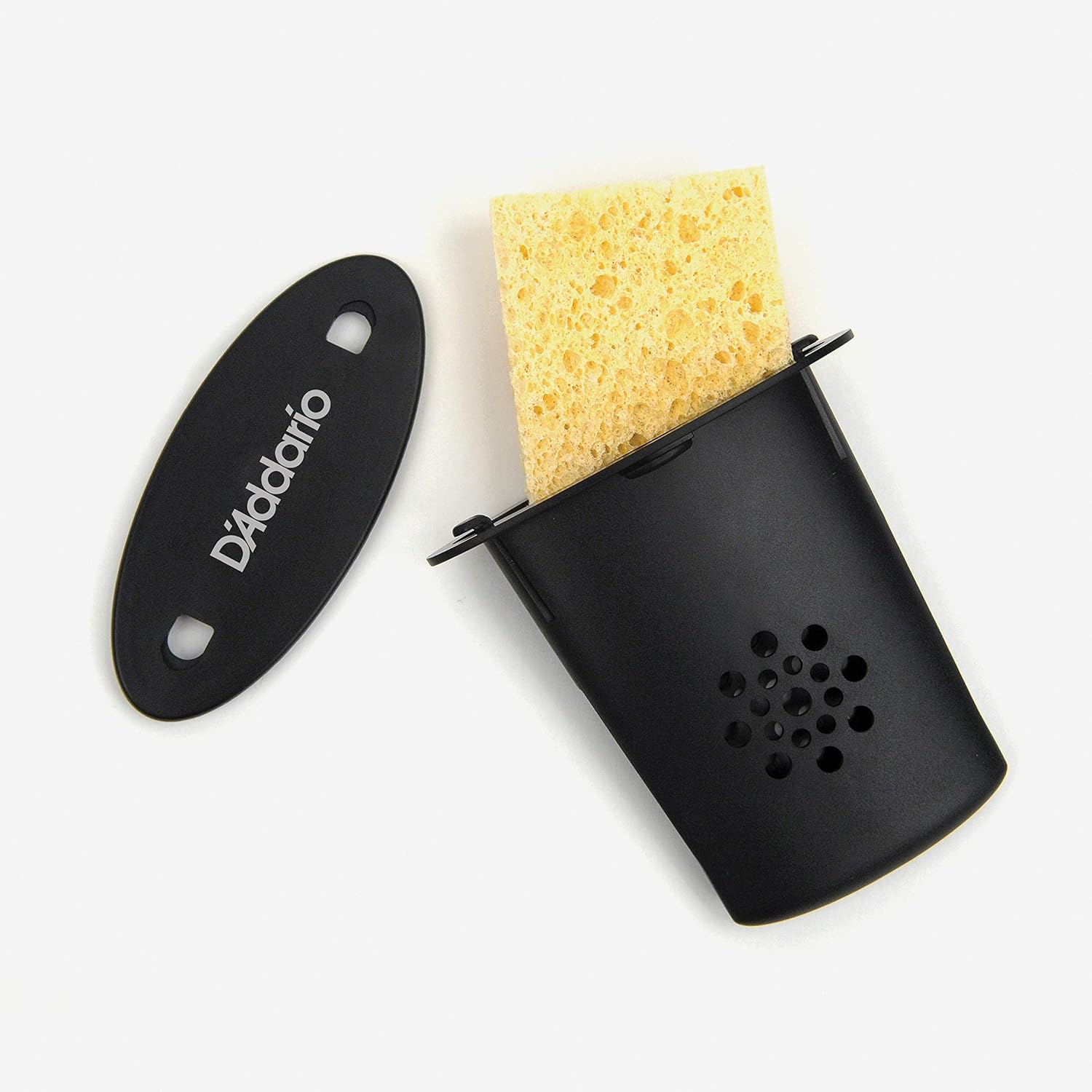
The best guitar humidifier for most acoustic players is a two-way humidity control pack like the D’Addario Humidipak, because it adds or removes moisture automatically and holds the guitar in the safe zone without you having to guess. A solid wood acoustic is a living thing, its thin top, back and sides shrinking and swelling as the air around it changes. Leave it too dry for too long and the wood will crack. You rest the guitar by a radiator through a cold winter and one day spot a hairline split along the top. It was avoidable, and a cheap humidifier would have prevented it. This guide explains how humidity affects a guitar, which type of humidifier suits which instrument, how to use one without overdoing it, and how to bring a dried out guitar back.
Why humidity matters
Wood is hygroscopic, so it absorbs moisture from the air and gives it back as the air dries. A guitar is built from pieces of wood dried to a set moisture content before they were glued together, and they want to stay roughly where the maker left them. The safe range for an acoustic is about 40 to 60 percent relative humidity, with 45 to 55 the sweet spot. Inside that band the wood holds its shape and the glue joints stay happy.
The problem is that British homes in winter sit a long way below that. Outside air on a British winter day is often 80 percent humidity or more, but warm that same air inside the house and the relative humidity falls, because warm air holds more moisture before it becomes saturated. Heated rooms commonly sit at 25 to 35 percent, and it drops lower overnight when the heating goes off and the air cools. At that point the wood gives up its own moisture and shrinks as it dries. A solid spruce or cedar top pulls tighter across the braces underneath, and eventually something gives. The top splits, the binding separates, or the finish develops fine checks. A crack through the top is structural work, not a ten minute fix. That risk is the reason the best guitar humidifier is worth buying before you need it rather than after.
The main types of guitar humidifier
A soundhole humidifier is the simplest and cheapest option, though there is no single best guitar humidifier, because the right one depends on where the instrument lives and how many guitars you keep. It is usually a small sponge or gel cartridge in a rubber sleeve that you slip into the soundhole when the guitar goes back in its case. You dampen the sponge and let it slowly release moisture into the body. The catch is that you have to re-wet it every few days, and it only ever adds moisture. Overdo it in a humid summer and you can push the guitar too far the other way. Squeeze the sponge out so it is damp rather than dripping, because a soaked one will run water into the wood.
Two-way packs like the D’Addario Humidipak work differently. The packs hold a gel that tries to keep the air around them at a set level, usually about 45 to 50 percent. Too dry and they release moisture, too damp and they absorb it. You drop the pouches into the soundhole and case and leave them alone. They last a few months before they harden into a solid slab, and because they work both ways you cannot over humidify a guitar by mistake. Three pouches cost roughly the price of a set of strings.
The third route is a case or room humidifier. A case humidifier clips to the case lining, while a room humidifier raises the humidity of the whole room. A room unit is genuinely useful if you keep several guitars out on stands. The catch is that a cheap ultrasonic unit throws a fine white mineral dust over everything, so you want distilled water or a decent evaporative model with a wick. Look for a tank of two litres or more if you want it to run overnight without a refill.
How to choose the best guitar humidifier for your guitar
The right answer depends on where the guitar lives, not on how much you want to spend.
One solid wood acoustic kept in its case is the easy case. A set of two-way packs, or a soundhole humidifier with a hygrometer, does the whole job. This is the situation where the cheapest option is also the most effective, because the case is a small sealed space.
A guitar that lives out on a stand is a different problem. A soundhole humidifier cannot help, because it needs a closed space to work in. Here you want a room humidifier, and a hygrometer to prove it is doing what you think. A single 4 litre evaporative unit will hold a small room in range through a reasonable winter.
If you keep several guitars out at once, the room is the sensible unit of management. Humidify the room, monitor it, and use case packs for the ones that spend most of their time latched up. Trying to run five soundhole humidifiers on a weekly rota is how people give up and let the guitars dry out.
Body shape changes the choice too. An archtop or jazz box has no usable soundhole, so a soundhole sleeve is useless and you want either a best rated guitar case humidifier or packs tucked around the body. A classical guitar has a soundhole, but some are tight enough that a large rubber sleeve will not sit comfortably, so a case humidifier is safer.
Electrics and basses rarely need anything. A solid body has no thin braced top to split, so the priority is lower. That said, a dry flat still moves the neck, so if you keep electrics out in a heated room through winter, a best rated room humidifier is cheap peace of mind for the whole collection.
A do it yourself option exists for anyone on a tight budget: a sponge in a ziplock bag with a few holes punched in it, tucked in the case. It works, it costs almost nothing, and it needs checking every couple of days. The reason people still buy a dedicated unit is that the routine is what fails, not the sponge.
Humidity in a British home, month by month
Knowing when the danger sits helps you decide when to bother. In the UK the pattern is fairly predictable.
October to December is when the heating comes on and the indoor air starts to dry out. Outside humidity is high, but the moment you warm that air it drops, and heated rooms settle around 30 percent. This is when most people first notice sharp fret ends.
January and February are the worst of it. Cold snaps mean the heating runs hardest, and a room can sit at 25 percent for weeks. Any solid wood acoustic left out of its case through this window is at real risk.
March and April are still heating season, and outside humidity starts to rise, so things ease slowly. Do not put the humidifier away at the first mild day, because a cold snap in March still dries a room out.
May to August is the reverse risk. British summers are often damp enough that a room drifts above 60 percent, especially in older houses and flats with poor ventilation. At that point you are trying to keep the guitar dry rather than wet, and a couple of silica packs in the case or a short spell of ventilation does more than any humidifier.
September is the switchover month. Heating goes on, nights get cold, and the first dry spell of the season arrives. A quick check of the relief and the fret ends in early October tells you whether your winter routine is working.
Measuring humidity accurately: hygrometers and the salt test
A hygrometer is the piece of the puzzle most people skip, and it is the one that makes everything else work. Without it you are either doing nothing or soaking a sponge every day on a hunch. A best rated hygrometer costs a few pounds, and you want one in the room and one in the case if you are actively humidifying.
Where you put it matters. A meter on a shelf reads the shelf. The case is a separate climate, and a case with a working humidifier can sit ten or twenty points higher than the room around it. If your room meter says 30 percent and your case meter says 48, the case is doing its job and you should leave it alone.
Cheap digital meters can be out by five or ten percent, which is a lot when the safe band is only twenty points wide. You can check one with a salt test. Put a spoonful of table salt in a small dish, add a few drops of water so it is damp but not dissolved, seal the dish and the meter together in a plastic bag, and leave it somewhere steady for eight hours. A meter reading 75 percent is accurate, and one reading 65 is ten points low, so you can allow for it or replace it.
Rehydrating a guitar that has dried out
If a guitar has been through a dry winter unprotected, it can usually be brought back, but it has to happen slowly.
Put the guitar in its case with a soundhole humidifier or a set of two-way packs, close the lid, and leave it. Aim to bring the humidity up to around 45 to 50 percent over two to four weeks, not two days. Wood takes on moisture gradually, and rushing it can swell the top unevenly, which is worse than the dryness you started with. Do not pour water into the body, and do not sit the guitar in a steamy bathroom.
Watch the fret ends as your gauge. Sharp fret ends that catch your hand are the clearest sign of a dry fingerboard, and as the guitar takes on moisture they settle back over a few weeks. If the top has developed a dip between the bridge and the soundhole, a slow rehydration usually lifts it. Once the guitar is stable, check the relief and the action, because a guitar that has moved will need a setup.
One honest note: rehydrating will not close a crack that has already opened, and it will not fix a brace that has come loose. Those are repair jobs, and humidifying around them just stops them getting worse. Even the best guitar humidifier pack will not work with the case sitting open, so keep the lid closed while the wood takes the moisture back.
Over-humidifying: the failure nobody warns you about
There is a mirror image of the dry guitar problem, and it happens to people who mean well.
Above about 60 to 65 percent humidity, and worse above 70, the wood swells. The top bellies up behind the bridge, the action creeps higher, and the guitar starts to feel stiff and dull. Glue joints soften, hardware corrodes, and in a bad case you get a musty smell and mould inside the case lining. A guitar kept in a damp basement or a conservatory through a wet British summer can end up in this state without anyone adding a drop of water.
The fix is to stop adding moisture and start removing it. Take the humidifier out, put a couple of silica packs in the case, and air the case in a dry room for a day. If the guitar has been wet long enough to smell musty, leave the case open in a warm dry room for a few days and replace the packs when they are spent. Prevention is a hygrometer reading above 60, which tells you the humidifier should come out for a while.
Maintaining and replacing humidifier consumables
Every humidifier has something that wears out, and knowing the schedule stops you being caught out.
Two-way packs go hard as a brick when they are done, and they cannot be revived. In a case with the lid on, expect two to four months of life, and a bit less if the room around them is very dry because they are working harder. Keep a spare set in the case pocket so you are never tempted to leave a dead pack in place.
Soundhole sponges and gel cartridges need re-wetting every two to three days during the heating season. Rinse the sponge now and then to keep it from going sour, and use distilled water if your tap water is hard, because minerals build up in the sponge and in the sleeve. A pack that starts to smell should be thrown away rather than re-wetted again.
Room humidifiers need the tank cleaned every week or two and the wick replaced once a season if you have an evaporative model. An ultrasonic unit left with standing water will grow a biofilm that then gets sprayed into the air, which is a genuine health nuisance and not just a guitar problem. If you can smell the tank when you open it, it is overdue a clean.
When dry damage needs a technician
Some dry weather damage is beyond a humidifier, and the earlier you spot it the cheaper it is.
A crack along the top or the back is the main one. A technician cleans the crack, glues it, and fits small cleats behind it to stop it travelling. In the UK, expect to pay from around £50 to £100 for a straightforward cleated crack, more if it runs the length of the instrument or crosses a brace. Leaving a crack open lets moisture and dirt into the wood and lets it spread, so get it looked at reasonably quickly.
A loose brace can be re-glued for a similar sort of money, and it is worth doing because a brace that has come adrift lets the top distort in ways that get worse over time. A lifting bridge is a reglue job, typically £60 to £120 depending on the instrument.
Sharp fret ends caused by fingerboard shrinkage are cheap to sort. A technician will dress the ends back so they no longer catch your hand, usually £30 to £60, and it is worth doing once the guitar is back in its humidified range so the fretboard has stopped shrinking. Some shops offer a seasonal check and service for a flat fee, which is a sensible rhythm for anyone with a valuable acoustic.
Recommended gear
These are the three things I would start with. Each is a real product type that does a specific job, and together they cover the common setup of one acoustic kept in its case.
D’Addario Humidipak holds the case around 45 to 50 percent in both directions, which means you cannot over humidify.
Soundhole guitar humidifier is the cheap entry point, best for one guitar in a case with a sponge you are happy to re-wet.
Digital hygrometer is the one to buy first, because everything else depends on knowing what the air is actually doing.
Frequently asked questions
Do electric guitars need a humidifier?
Rarely, and mostly not. A solid body electric is a thick slab of wood with far less surface area under tension, and it has no thin spruce top held together by braces. It can still dry out enough to move the neck, which shows up as sharp fret ends and a drifting setup, but a split top of the kind you see on acoustics is unusual on a solid body. A room humidifier helps, but it is not the priority a solid top acoustic is.
What happens if my guitar gets too dry?
The wood shrinks as it loses moisture, and because a guitar is glued together from different pieces, they do not all shrink at the same rate. The top is the weak point. Held under tension by the strings, it will split along the grain, often near the centre seam. Fret ends poke out, the top can dip, and in serious cases the bridge can start to lift. A cracked top is structural work and always affects the value of the guitar.
How do I know if my guitar is too dry?
The quickest check is the fret ends. Run your hand along the edge of the neck and if the frets feel sharp or stick out past the wood, the fingerboard has shrunk and the guitar is drying out. Then look at the top. If it looks slightly sunken between the bridge and the soundhole, or the finish shows a rippled, wavy look, the wood is dry. Sharp frets are the sign you can feel without any tools.
Is a room humidifier enough on its own?
For one guitar kept in a case, no. A case or soundhole humidifier is more reliable because it works in a small, closed space you can genuinely control. A room humidifier only wins when you keep several guitars out on stands. The best setup for a room full of instruments is a decent room humidifier monitored with a hygrometer.
How long does a guitar humidifier last?
Two-way packs last two to four months in a closed case before they harden, and the sponge types need re-wetting every two to three days but will keep going for years if you clean them. A room humidifier will run for years with a weekly clean, though the wick on an evaporative unit wants replacing once a season.
Can a guitar be too humidified?
Yes, and it is more common than people think. Above about 60 percent the top bellies up, the action rises, hardware corrodes, and the case can go musty. Damp British summers cause it without anyone adding water. If your hygrometer reads high, take the humidifier out and put a couple of silica packs in for a while.
Do I need a humidifier in summer?
Usually not, and in a wet British summer you may need the opposite. Outside humidity in July and August is often high enough that a guitar in a case stays comfortably in range on its own. Keep an eye on the hygrometer, and if the reading climbs past 60 percent, ventilate the room and dry the case out rather than humidifying it.
Still comparing acoustics before you worry about humidity? Have a look at our guitar comparison tool to weigh up your options side by side.
*As an Amazon Associate, I earn from qualifying purchases. Links on this page are affiliate links, marked with rel=”sponsored”.*