
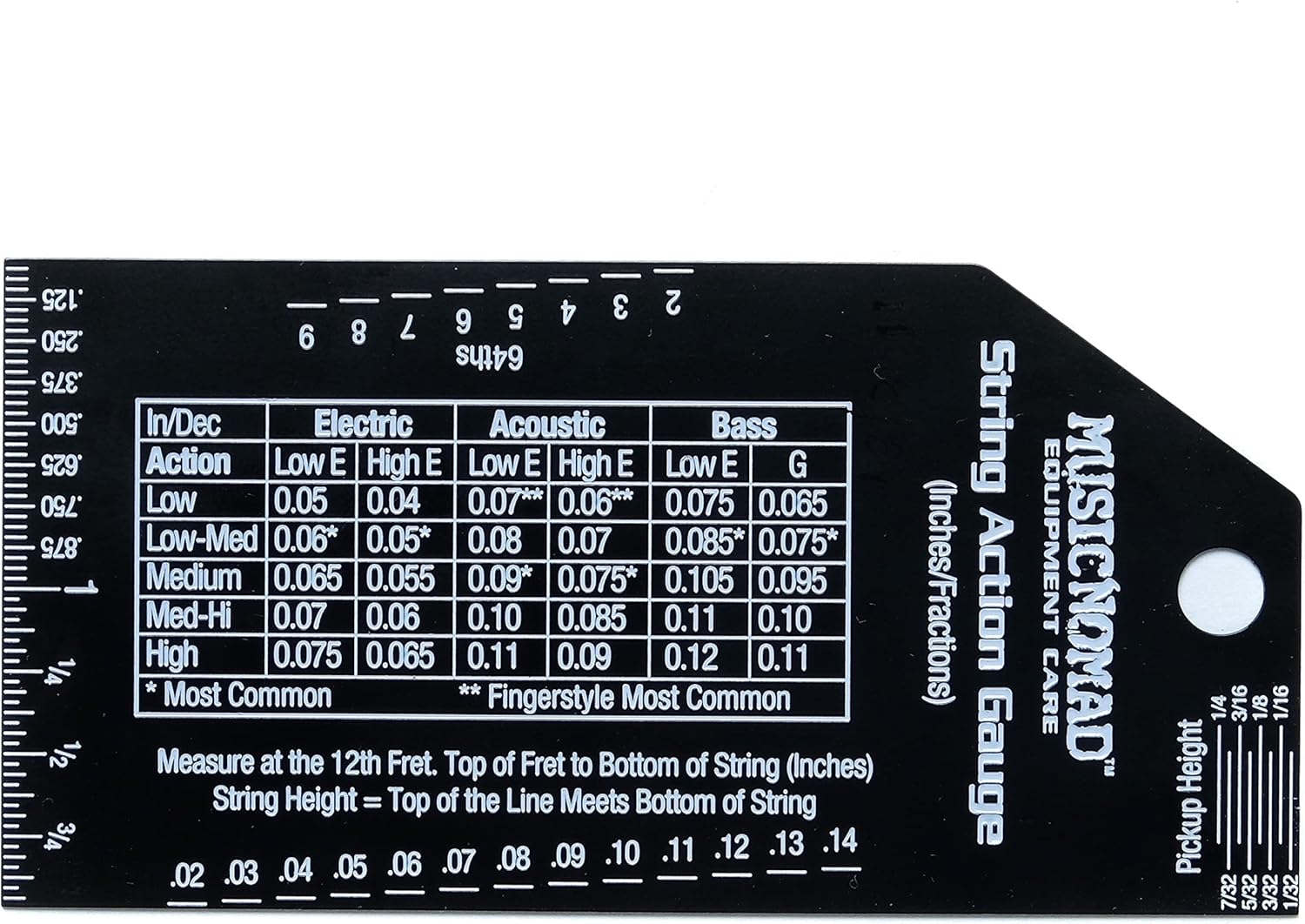
Guitar action too high is a problem you can fix at home, and the job is done in three steps: check the neck relief first, then lower the bridge saddles, and finally sort out the nut height. Action is the gap between the strings and the tops of the frets. When that gap is too large the strings need more pressure to ring cleanly, bends and barre chords feel like hard work, and the guitar just plays stiff. The good news is that lowering it is mostly small, reversible adjustments you can make with a couple of inexpensive tools, and every step can be undone if you go slowly. This guide runs through the whole job in the right order, from measuring what is actually wrong to setting the height at the bridge and the nut, and it covers what to do when the first three fixes are not enough.
Diagnose the cause first: measure the neck relief
Before you turn a single screw, work out where the extra height is actually coming from. String height is the result of three things: the bow in the neck (called relief), the height of the bridge saddles, and the depth of the nut slots. If you guess and start adjusting the wrong one, you can make the guitar worse while fixing nothing.
The first measurement to take is relief. Fret the low E string at the first fret (a capo makes this easier) and at the fret where the neck meets the body, which is usually around the 14th fret on many guitars. Now look at the gap between the string and the frets around the 7th or 8th fret. You want a tiny amount of daylight there, roughly 0.25 mm, or about the thickness of a business card. If you have a feeler gauge, the strip you slide in should just drag.
If the gap is much bigger than that, the neck is bowed forward with too much relief, and the strings sit high around the middle of the fretboard. If there is no gap at all, or the string touches the frets, the neck is back bowed or dead flat. This single measurement tells you whether the truss rod needs a tweak or whether you should leave it alone and move straight to the bridge. Taking it first is what stops you wasting an afternoon.
Guitar action too high: the four causes in order
Almost every case comes down to one of four things, and they are worth checking in this sequence.
The first is neck relief, the forward bow of the neck. Too much relief lifts the strings away from the frets across the middle of the fretboard, which is exactly where you spend most of your time playing chords.
The second is the saddle or bridge height at the bridge itself. This is the adjustment most people mean when they talk about lowering the action, and on an electric it is the easiest of the four to change.
The third is the nut. If the nut slots are cut shallow, the strings sit high over the first few frets even when everything else is right, and open chords feel harder than barred ones, which is usually a sign that the nut is the problem.
The fourth is neck angle, and it is the one people miss. On an acoustic in particular, the height of the strings can be high even when the relief is right and the saddle is already low, because the neck has leaned forwards over time. No truss rod adjustment fixes that, and it is where the job stops being a setup and starts being a repair.
Check them in that order, because the first three are cheap and reversible and the fourth is neither.
Fix 1: adjust the truss rod
The truss rod is a metal rod running inside the neck that works against the pull of the strings and controls how much the neck bows. Tightening it pulls the headstock back and reduces relief, which straightens the neck and lowers the strings around the middle frets. Loosening it does the opposite and adds a little bow.
The rule to remember is clockwise tightens and anti-clockwise loosens, and the golden rule is small turns. A quarter turn at a time is plenty. Retune after each turn, let the neck settle for fifteen minutes or more, then measure the relief again. Use the correct size hex or Allen key, which is often supplied with the guitar, and never force the rod. If it is very stiff, makes a clicking sound, or you have to lean on it, stop and take the guitar to a technician. A broken truss rod is an expensive repair.
If the relief measured in the previous step is already fine, skip this section entirely. The truss rod is not a height adjuster, and people ruin necks by cranking it to try and lower the action when the real problem is at the bridge.
Fix 2: lower the bridge saddles
Once the relief is right, the next place to look is the string height at the 12th fret, and most of that height is set at the bridge. On an electric guitar you lower the action either with the small height screws on each individual saddle, as on a Strat or Tele, or with the two bridge posts on a tune-o-matic. On an acoustic the saddle is usually one piece of bone or plastic sitting in a slot, and lowering it means sanding material off the bottom, which is a slower job.
For electrics, lower each saddle in small steps while keeping the curve of the fretboard in mind, so the middle strings are not sitting much higher than the outside strings. Lower a little, retune, play every fret up the neck, and listen for buzz. Your target is roughly 1.5 to 2 mm at the 12th fret on the high E and around 2 to 2.5 mm on the low E, but the real guide is how the guitar feels and whether it buzzes. If a string starts to buzz before you reach a comfortable height, raise that saddle a fraction and that is your floor for now.
One thing worth knowing about the order of work. Lowering the saddles changes the length of string behind the saddle, which shifts the intonation, so do not bother setting intonation until the action is where you want it. If you set the intonation first and then drop the action, you will be doing the whole thing twice.
Fix 3: sort out the nut height
The nut is the last piece and the one people most often forget. If the slots in the nut are too high, the strings sit high over the first few frets even when the action at the 12th fret is already low, and open chords feel harder to press than they should.
The test is simple. Fret a string at the third fret and look at the gap between that string and the top of the first fret. You want the tiniest sliver of space, barely visible. If there is a clear gap, the nut slots are too high.
Fixing this means deepening the slots with a set of nut files, and it is the most delicate step in the whole guide. Take one or two strokes per slot and recheck constantly, because if you file too far the open string will buzz and you are looking at replacing the nut. It is a cheap job for a technician and a fiddly one to get right by hand, so if you are not confident this is the one step where handing it over is sensible.
Fix 4: neck angle and shims, when the first three are not enough
If the relief is correct, the bridge is low and the nut is right, and the action is still too high, then the geometry of the guitar is the problem.
On a bolt-on electric, the fix can be a neck shim. A thin shim in the neck pocket tilts the neck back slightly, which lowers the strings. This is a well established trick on Fender style guitars, and a sliver of card or a purpose made shim can turn a guitar with a badly set neck into a good one. It is reversible and cheap, and a tech will do it in minutes if you would rather not loosen the neck yourself.
On an acoustic, the same diagnosis leads somewhere more serious. If you lay a straight edge along the frets towards the bridge and it lands below the top of the bridge rather than just above it, the neck angle has drifted. In that situation the saddle is usually already low, and the correct repair is a neck reset, where the neck is removed and refitted at the right angle. It is a skilled job and it costs several hundred pounds, but there is no truss rod or saddle trick that substitutes for it.
One more thing to look for is a twisted neck, where one side of the fingerboard sits higher than the other. Hold the guitar up and sight down the neck from the headstock. If the bass side and treble side are not behaving the same way, stop adjusting and get a technician to look, because relief adjustments assume the neck is behaving symmetrically.
Measuring relief and action accurately
You can do this by eye, and plenty of people do, but the numbers make the difference between a guitar that is comfortable and one that is nearly comfortable.
For relief, a feeler gauge beats a business card because it can tell you the difference between 0.2 and 0.3 mm, and on a well set up guitar that difference is the difference between clean and buzzing. The method is the same as the one above: capo at the first fret, press the string at the body joint, and slide the gauge into the gap around the 7th or 8th fret.
For action, a best rated string height gauge sits across the frets and reads the gap at the 12th fret directly, which removes the squinting. Measure all six strings, not just the two outside ones, and measure at the pitch you actually play at rather than a slack tuning.
A useful reference for electrics is 1.2 to 1.6 mm on the high E and 1.6 to 2.0 mm on the low E at the 12th fret. For an acoustic, 1.8 to 2.2 mm on the high E and 2.2 to 2.8 mm on the low E. A bass sits higher, commonly 2 to 3 mm. Classical guitars are higher again, often around 3 mm on the low E, because the lower string tension needs more room to vibrate without buzzing.
Temperature matters when you measure. A guitar that has just come indoors from a cold car will read differently from one that has been in the room for an hour, so let it settle before deciding anything.
Lowering action by guitar type
The same four causes apply to everything, but the tools are different.
On a Strat or Tele, each saddle has two height screws, one at each end, and you turn them evenly so the saddle stays level. Intonation is set with a separate screw behind each saddle. It is the most adjustable bridge there is, and the hardest part is keeping the radius of the saddles matched to the curve of the fretboard.
On a tune-o-matic, as found on most Les Pauls and SGs, the height is set with two thumbwheels on the bridge posts, one at each side, and it is a genuinely quick adjustment. The catch is that the bridge has a fixed radius, so if the fretboard has been refretted with a different radius the strings will not follow it exactly.
On a floating tremolo, lowering the action at the two pivot posts changes the bridge angle and therefore the tuning of every string, so you must retune after every small change. Intonation on these takes patience, because moving one saddle shifts the balance of the whole system.
On an acoustic, the only real adjustment is the saddle. Sanding the bottom of the saddle lowers the action, and the rule of thumb is that taking 1 mm off the saddle lowers the action at the 12th fret by about 0.5 mm, because the 12th fret is halfway along the string. Keep the bottom of the saddle flat, because a saddle sitting on an uneven base will rock and kill the tone.
On a classical guitar there is often no truss rod to adjust, so the action is whatever the saddle and nut give you. A high action on a classical usually means sanding the saddle, and the numbers wanted are much larger than on a steel string because nylon vibrates in a wider arc.
Acoustic action: saddles, shims and the neck reset question
Acoustics deserve their own section, because the options run out faster than they do on an electric.
Start with the relief, as always. A lot of acoustic action problems are really truss rod problems, and the fix is the same quarter turn and wait routine. If the relief is right, move to the saddle.
Check how much saddle is showing above the bridge. If there is a healthy height of saddle and the action is high, you can sand it down. If the saddle is already sitting nearly flush with the bridge, sanding is no longer an option, because there is nothing left to remove and the strings need some downward angle over the saddle to transfer energy into the top.
At that point you are looking at the neck angle, and the straight edge test tells you which way. If the geometry is wrong, the answer is a neck reset, and in the UK that typically runs from £250 to £450 on a guitar with a glued in neck. Before committing, it is worth knowing what the guitar is worth, because on a budget instrument the repair can exceed the value.
Two smaller things can help an acoustic play better without a reset. A new, correctly fitted bone saddle costs roughly £30 to £60 and lets a tech set the height and the intonation at the same time, and if the neck is close to right a shim under the saddle can lift the action when it has gone too low. Both are worth asking about before you agree to major work.
Truss rod safety: read this before you turn it
The truss rod is the one adjustment on a guitar that can cause serious damage, so here are the limits.
Never force it. If it will not turn, if it clicks, or if you have to put real weight behind it, stop and hand the guitar over. A seized rod can sometimes be freed by a technician, and a snapped one can mean an expensive repair or a new neck.
A quarter turn is a big adjustment, not a small one. Retune and wait fifteen minutes after each turn, then measure again. The wood moves in its own time, and chasing it with the wrench is how a neck ends up back bowed.
Use the right tool. A key that is a loose fit in the nut will round off the corners, and then no key will fit. Fenders commonly take a 3/16 inch key, many Gibsons take a 5/16 inch socket, and a lot of import guitars take 4 mm.
Accept what the rod cannot do. It controls relief, nothing else. If the relief is already in range and the action is still high, the answer is at the bridge, the nut, or the neck angle, and turning the rod further will only spoil the neck.
Setting the action for your playing style
There is no single correct action height, because the right number depends on how you play. Guitar action too high is not always a fault either, because a slide player wants it high on purpose.
If you strum hard with a heavy pick, you want the action at the upper end of the range, because a low action will rattle and buzz under a firm attack. Players who strum acoustics with a lot of attack often end up at 2.5 to 2.8 mm on the low E and are happier for it.
If you play fingerstyle or soft picking, you can go lower, because the strings are not being driven as hard. This is where a nicely adjusted acoustic at around 2 mm on the low E feels responsive rather than stiff.
If you bend a lot, as most electric players do, you want the action low enough to bend comfortably but high enough that a bend does not choke out somewhere up the neck. Choking on a bend is usually a sign you have gone slightly too low or that a fret is uneven, and it is worth raising the action a fraction before blaming the frets.
If you play slide, you want the action higher than comfortable for fretting, because the slide needs clearance over the frets. Slide players often run the same guitar noticeably higher and simply accept a stiffer feel when fretting.
After you lower the action: intonation and buzz checks
Lowering the action is not the last step, because two things change as soon as you do it.
The first is intonation. Dropping the saddles alters the string’s speaking length, and the effect is larger than most people expect on a guitar where you have moved several saddles. Retune, then check the 12th fret harmonic against the fretted 12th fret note on each string, moving the saddle back if the fretted note is sharp and forwards if it is flat.
The second is buzz. Play every string at every fret, and play harder than you normally would, because buzz shows up under attack first. A light touch that never buzzes in the shop can rattle the moment you dig in with a pick. If one spot buzzes, look at the fret there before you raise the whole bridge, because a single high or low fret is a fret problem and not an action problem.
Then play the whole guitar as you would in a session, chords, bends, single notes, and up at the dusty end of the fretboard near the body. The numbers get you close, and playing is what confirms the job.
When guitar action too high means a repair, not a setup
There is a point where guitar action too high stops being an adjustment and becomes a repair job, and getting there is worth the money.
The clearest sign is an acoustic with high action and a low saddle, where the straight edge test says the neck angle has gone. That is a neck reset, and no amount of truss rod work will change it. Expect several hundred pounds, and a conversation with the technician about whether it is worth doing on your instrument.
A nut that is cut too low, or worn so the slots have sunk, cannot be built back up. A new nut costs roughly £40 to £80 fitted and fixes open string buzz and stiff first position action in one go.
Worn or uneven frets are the other big one. If a note chokes, buzzes at one fret, or sounds dead when the action is comfortable, the fret is the problem, not the height. A fret level, crown and polish typically runs from £80 to £150 in the UK, and it is one of the best value jobs in guitar repair.
A twisted neck is rare, and it is the one to stop and hand over. If the neck looks like it is leaning to one side when you sight down it, a technician needs to look before anything else is adjusted.
Transport, temperature and action drift
A guitar that is set up perfectly in July can feel stiff and high by January without anything being wrong with it.
The cause is the wood moving. Dry heated air shrinks the fingerboard and the wood of the neck, which changes the relief, and the top of an acoustic sinks slightly, which raises the action. A guitar left near a radiator through the winter is the worst case, and it will drift more than one kept in a case at a steady humidity.
The fix is partly a setup and partly a habit. Keep the guitar out of direct sun and away from radiators, hold the room in the 40 to 60 percent humidity range, and recheck the relief and the action each October before the heating has been on for long. Small measurements taken early save a big adjustment later.
Travel does the same thing faster. A guitar that has been in a cold van or a shipping box should be allowed to come up to room temperature before you judge the action, because a cold guitar reads differently and a cold neck feels different under your hand. Give it an hour, then play it, then measure if it still feels wrong.
Recommended gear
You do not need a workshop full of tools for this. The three below cover the whole job, and they cost less than a single paid setup. The links are affiliate links, which means I may earn a small commission at no extra cost to you.
- Guitar action ruler string height gauge: a small metal card marked in millimetres and fractions of an inch, so you can actually see your string height instead of guessing.
- Guitar truss rod wrench set: the correct size hex and socket keys for most common truss rod nuts, which beats using whatever key happens to fit.
- Feeler gauge set: thin metal strips that make measuring neck relief far more accurate than a business card.
Two more are worth having if you are going to check your own work accurately. A best rated guitar capo holds the string down at the first fret so both hands are free for the gauge, and a best rated clip-on tuner means you can retune quickly between every small adjustment.
Frequently asked questions
What is a good string height for a guitar?
A comfortable starting point is around 1.5 to 2 mm at the 12th fret on the high E string and roughly 2 to 2.5 mm on the low E. Acoustic players and heavy strummers often prefer the top of that range, while electric players who bend a lot lean lower. These are targets, not rules, and the right height is the lowest you can get without buzz.
Does high action mean my neck is bowed?
Not necessarily. A bowed neck with too much relief is one cause, but high saddles and high nut slots are just as common, and often two or three of these are wrong at once. That is why you measure the relief first and check the nut before assuming the truss rod needs moving.
Can I lower the action without a truss rod wrench?
Usually yes. If the relief measurement is already in the right range, the action is lowered at the bridge, and you only need the small hex key or screwdriver that fits the saddle height screws. The truss rod only needs adjusting when the neck itself is bowed, so a truss rod wrench is only essential if that measurement says so.
When should I leave it to a professional?
If the truss rod is stiff or clicking, if the neck looks twisted rather than evenly bowed, if the frets are worn or uneven, or if you have filed a nut slot too far, stop and take the guitar to a technician. A full setup is one of the cheapest improvements you can buy, and it is always cheaper than a repair.
Can I lower the action too far?
Yes, and it is the most common mistake people make on their first attempt. Go too low and the strings buzz on the frets when you play with any attack, bends choke out, and the tone loses body because the strings have less room to vibrate. If that happens, raise the saddles a fraction rather than starting over, and always judge the result while playing hard rather than softly.
How much does it cost to have the action lowered?
A standard setup, which covers relief, action and intonation, typically costs £40 to £70 in the UK. If the work turns into repairs, expect more: a new nut is around £40 to £80 fitted, fret levelling runs from about £80 to £150, and an acoustic neck reset is several hundred pounds.
Will lowering the action affect my tone?
It can, slightly. Lower action gives the strings less room to move, which can thin the sound a little and reduce how hard you can play before it buzzes. Most players find a well set up low action sounds better because their playing is cleaner. If you want maximum volume and punch for strumming, a slightly higher action is the usual answer.
If you are still deciding which guitar to buy, our guitar comparison tool compares live asking and sold prices across models.
*As an Amazon Associate, I earn from qualifying purchases. Links on this page are affiliate links, marked with rel=”sponsored”.*