
Guitar belly bulge is the soundboard of an acoustic lifting behind the bridge. A rise of up to about 3mm is normal and built in, because the top is domed on purpose. Past 4mm, or with a bridge tilting forward, the top is losing its fight with tension and needs looking at.
Key takeaways
- Acoustic tops are domed by design, so a steel rule laid across the lower bout will always rock a little. That alone is not a fault.
- Up to 3mm behind the bridge is normal. Between 3mm and 5mm, measure monthly at 45 to 55% humidity. Over 5mm, get it assessed.
- Dry air causes more of this in the UK than age does. Central heating from October to March does heavier damage than twenty years of tension.
- Early bellies often settle with three weeks of correct humidity and a lighter gauge. A structural one needs a brace reglue or a Bridge Doctor.
- Never rehydrate fast. Going from 30% to 55% in a day can split a finish and open seams.
What guitar belly bulge actually is
An acoustic soundboard is not a flat sheet. It is braced into a shallow dome near a 25 to 28 foot radius, and that curve is part of how the instrument works. Lay a straight edge across the lower bout of a healthy guitar and the rule touches at the edges with a gap in the middle. That gap is the design.
String tension does the rest. Six strings at pitch pull the bridge towards the headstock with roughly 160 to 190 pounds of force, and the bridge sits on the thinnest, most flexible part of the top. The assembly rotates forward slowly, the area behind the bridge lifts and the area in front of it sinks.
Three things get called belly bulge, and you need to separate them before spending money.
- The designed dome behind the bridge. It has been there since the guitar was built.
- A bridge rotating or lifting. The glue joint at the back edge is failing and the bridge tips towards the soundhole. That is a repair, not a humidity problem.
- A sinking top in front of the bridge. The top between bridge and soundhole drops, usually a loose brace or a worn bridge plate. This is the serious one.
How to measure guitar belly bulge in five minutes
A 300mm steel rule, a set of feeler gauges and the torch on your phone will tell you almost everything.
- Tune to pitch first. Slack strings hide the problem completely.
- Lay the rule across the lower bout, parallel to the bridge, just behind it, resting on the outer edges of the top. Do not press down.
- Fill the gap with feeler gauges at its deepest point and read the total. A cheap set of feeler gauges covers the range and lives in the case afterwards.
- Repeat in front of the bridge. This should be close to flat, and a dip of 2mm or more is structural.
- Check the bridge. Lay the rule along its length, then try a 0.10mm gauge under the back edge where the bridge meets the top.
- Measure action at the 12th fret with a string action gauge. A belly that has pushed action up by a millimetre matters more than the belly alone.
- Look inside with your phone on video, flash on, slid through the soundhole. Check the X brace ends near the waist, the tone bars and the bridge plate. A loose brace shows as a dark line and often clicks when you press the top.
| Measurement | How to take it | Normal | Watch | Act now |
|---|---|---|---|---|
| Belly height behind bridge | Rule across the lower bout, gauge in the gap | 0 to 3mm | 3 to 5mm | Over 5mm |
| Top height in front of bridge | Same method, bridge to soundhole | Flat to 1mm hollow | 1 to 2mm hollow | Over 2mm hollow |
| Bridge rotation | Rule along the bridge, gauge under back edge | Under 0.10mm | 0.10 to 0.30mm | Over 0.30mm open |
| Action at 12th, low E | Action gauge, string open | 2.0 to 2.8mm | 2.8 to 3.2mm | Over 3.2mm with no relief left |
| Relative humidity | Digital hygrometer beside the guitar | 45 to 55% | 40 to 45%, or 55 to 60% | Under 35% or over 65% for a week |
| Brace condition | Torch and phone camera inside | No gaps, no rattle | Slight click | Visible gap |
What a healthy setup measures like
Since the rule is out, check the setup too. Working ranges on a healthy guitar at pitch and correct humidity:
| Guitar type | Relief at 7th fret | Action, low E at 12th | Action, high E at 12th |
|---|---|---|---|
| Dreadnought, 12-53 strings | 0.20 to 0.25mm (0.008 to 0.010in) | 2.4 to 3.0mm (3/32 to 7/64in) | 1.8 to 2.2mm (5/64in) |
| OM or 000, fingerstyle | 0.20mm (0.008in) | 2.2 to 2.6mm | 1.6 to 2.0mm |
| Jumbo or slope shoulder, 13-56 | 0.25mm (0.010in) | 2.6 to 3.2mm | 2.0 to 2.4mm |
| Classical or nylon strung | 0.25 to 0.30mm | 3.5 to 4.0mm | 3.0 to 3.5mm |
| Electric, 10-46 strings | 0.20 to 0.25mm | 1.6 to 2.0mm | 1.2 to 1.6mm |
Fix the relief before judging the action, but do not expect it to rescue a belly. Taking 0.10mm of relief out drops the 12th fret action by around 0.04mm, which is nothing against a 5mm rise. Our action too high guide has the order of operations.
The four causes, ranked by how often they turn up
Dry air, the big one in the UK
Wood shrinks across the grain as air dries, and a soundboard is a wide, thin sheet under load. Below about 40% relative humidity the plate shrinks and stiffens unevenly while the braces stay put, and tension starts to win. The same dry air shrinks the fretboard, which is why fret sprout often arrives alongside a belly. A heated UK house in January sits at 30 to 40% for weeks, which is behind most bellies on guitars only a few years old.
String tension that never lets up
A set of 13s pulls roughly 15 to 20% harder than 12s on the same guitar. If it was braced for lights, that extra load goes into the bridge and the X brace. Detuning a semitone when it is not being played takes a useful amount off and costs nothing.
Loose or failed braces
Braces are glued, and glue joints eventually give. The suspects are the X brace ends near the waist, the bridge plate under the pin holes and the tone bars. A loose brace lets the top move as two panels instead of one plate, giving a belly in one area and a dip in another, and it can buzz on certain notes. If a fret buzz appears at one or two pitches and the frets look level, check the braces first.
Bridge plate wear and saddle lean
The ball ends bear on the bridge plate, a maple plate glued inside the top. Twenty years of tension wears grooves in it, and once it is chewed through the ball ends pull up into the top. The saddle also leans forward as the bridge rotates. Both are fixable.
Which case are you in?
| What you see | Quick test | Likely cause | First move |
|---|---|---|---|
| Smooth belly across the width, flat in front of the bridge | Rule and gauges, no bridge gap | Dry air plus normal tension | Read the humidity, rehydrate three weeks |
| Belly and action has crept up over one winter | Action gauge against last year’s note | Dry air, top has not recovered | Humidify, recheck before the truss rod |
| Belly with a gap under the back of the bridge | 0.10mm gauge under the bridge edge | Bridge glue joint failing | Slacken strings, book a reglue |
| Belly, a dip in front, clicking when pressed | Torch inside, gentle press on the top | Loose brace or bridge plate | Luthier assessment, not just humidity |
| Belly only on one side of the lower bout | Rule across, then along the body | Single brace or a twisted top | Luthier assessment |
| Belly with a crack from bridge to tail | Visual, cotton bud along the crack | Impact or long term dryness | Slacken strings and get it seen |
| Belly on a guitar bought used last month | Serial number, photo of the bracing | Already there, or shipping dried it | Rehydrate, then judge once stable |
Most readers land on the first or second row. If that is you, do not book anything yet. Three weeks of correct humidity answers the question on its own.
Fix one: get the humidity right
Nothing structural should be decided while the guitar is dry, because a dry guitar lies. A top measuring 4mm in February may measure 2.5mm in May with no repair at all.
The target is 45 to 55% relative humidity, which Martin and Taylor both specify. You cannot manage what you cannot see, so buy a hygrometer first. A best rated digital hygrometer in the case costs about a tenner and removes the guesswork. Weather apps give the outdoor figure, which is not the number that matters.
- One guitar, work in the case. A D’Addario soundhole humidifier between the strings plus a closed case beats humidifying a room.
- Several guitars, work in the room. Small room humidifier, door shut, hygrometer on the wall.
- Distilled water only. Tap water leaves mineral deposits on the top.
- Bring it up slowly, about 5% every few days. Fast rehydration is how finishes craze and seams open.
- Check weekly and write the belly measurement down. The trend beats any single reading.
There is a failure mode the other way. Push a guitar over 60% for a week and the top swells, the action climbs and the joints soften. Taylor’s notes on the symptoms of a wet guitar cover that side, and if the belly grows while the hygrometer reads 65%, stop adding water.
Fix two: take some tension off the top
Once humidity is stable, the cheapest structural help is less string pull.
- Drop a gauge. Moving from 13-56 to 12-53 takes a noticeable load off the bridge and is the standard fix for a developing belly. Our string gauge guide explains how far you can move without losing the sound you paid for.
- Tune down a semitone. Fine if you play alone. It removes roughly 5 to 8% of the tension for the price of a capo.
- Slacken the strings for storage, down a tone or two rather than floppy. Read our guitar storage guide before anything goes in a loft.
Fix three: the Bridge Doctor, and when it is the right call
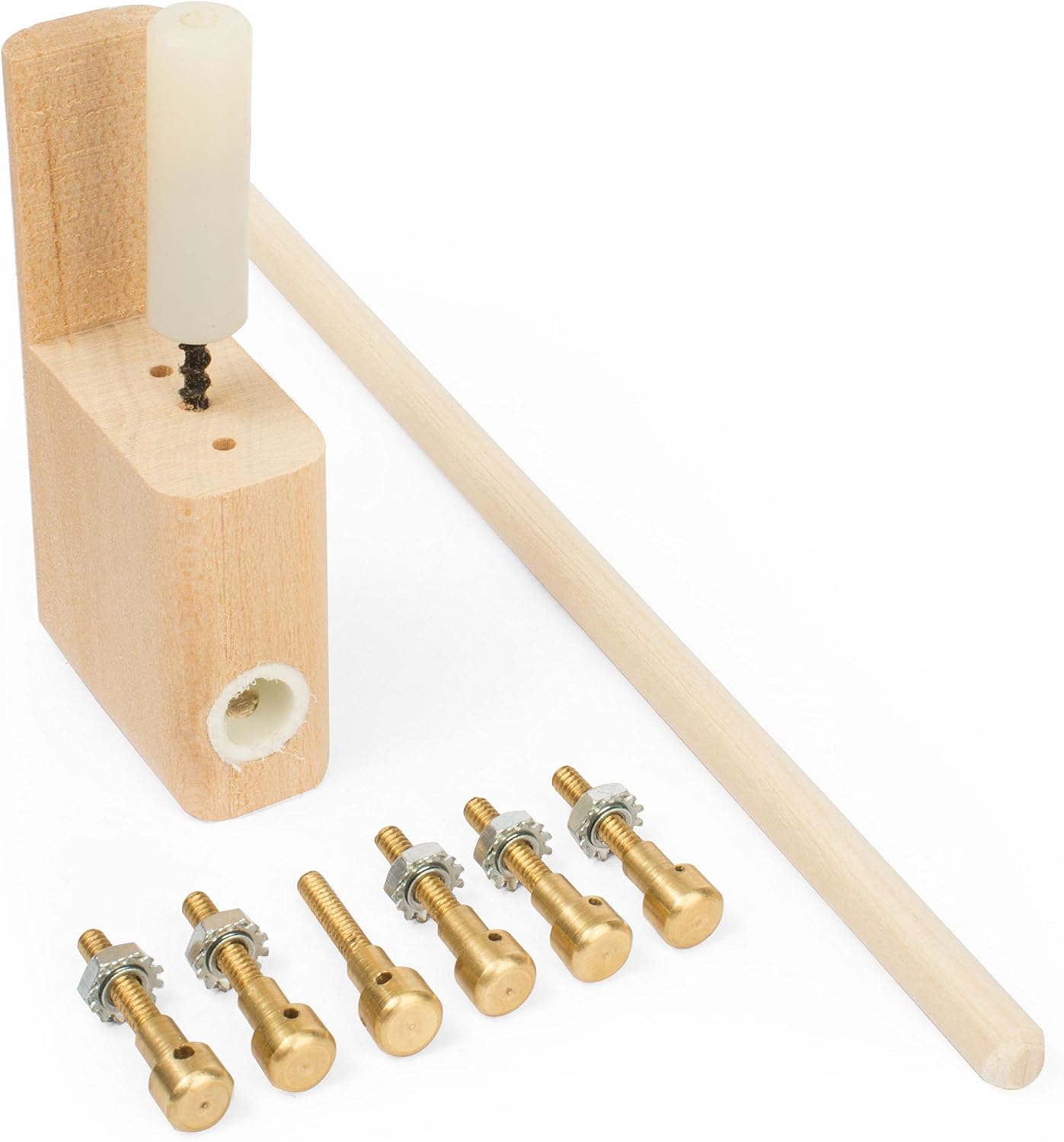
The JLD Bridge Doctor is the one product that directly addresses a belly humidity will not fix. A wooden block sits against the tail block inside the guitar, a dowel runs forward to the bridge, and brass pins through the bridge pin holes pull the bridge down onto the dowel. It levers the belly back towards flat, which makes it an internal brace fitted after the guitar was built.
When it works:
- Good candidate. Belly of 4 to 6mm, braces sound, bridge glued solid, no cracks, action risen but with room left at the saddle, and a guitar you intend to keep.
- Wrong candidate. A loose brace (fix that first, this will not hold a moving panel), a lifting bridge, a top crack, a guitar worth less than the repair, or one you plan to sell. Dealers spot the brass pins immediately.
Expect 1 to 3mm out of the belly over a few weeks, adjusted in small turns. Expect a change in sound too: it adds mass and stiffness under the bridge, which most players describe as a tighter bass and less airy response. On a £400 workhorse that is a fair trade. On a vintage Martin, decide with a luthier.
Fitting is within reach of a careful DIY player because the pin holes already exist, but you are drilling into a bridge. A luthier will do it in an hour with the top supported. The JLD Bridge Doctor with the brass pin mount is about £61 in the UK at the time of writing. It leaves screw holes and a dowel inside the guitar, so it is not a reversible experiment.
Fix four: brace and bridge work from a luthier
If the diagnosis points at a loose brace or a worn plate, this is bench work, not a product.
- Brace reglue. The luthier works through the soundhole with long clamps and a mirror, cleans out old glue and clamps the brace back down.
- Bridge plate patch. A thin hardwood overlay over the worn area so the ball ends have fresh wood to bear on.
- Bridge reglue. The bridge comes off, old glue is cleaned back to bare wood on both surfaces, and it goes back on with clamps and a caul. Regluing over old glue will lift again.
- Neck reset. The last resort when the action cannot come down because the neck angle has shifted against a rotated top. Rarely worth it on a guitar under £500.
All of these hold better if the guitar then lives at the right humidity. A bridge reglue on a guitar that goes back beside a radiator is money spent twice.
What a UK repair costs in 2026
Realistic bench prices from published luthier rate cards. Most workshops charge around £25 an hour plus parts, with a minimum bench charge near £35.
| Job | Typical UK price | What it covers | DIY possible |
|---|---|---|---|
| Assessment and written quote | Free to £35 | Measurement, brace inspection, verdict | No |
| Full setup with new strings | £65 to £100 | Relief, action, intonation, clean | Yes, with care |
| Hygrometer and soundhole humidifier | £15 to £40 | The rehydration stage | Yes |
| Brace reglue, single brace | £80 to £150 | Cleaning the joint, clamping, glue | No |
| Bridge plate patch | £90 to £180 | Hardwood overlay under the pin holes | No |
| Bridge reglue | £75 to £120 | Bridge off, old glue removed, clamped | No |
| Bridge Doctor, part only | About £61 | The unit itself | Yes, if you can drill accurately |
| Bridge Doctor, fitted | £110 to £160 | Part plus an hour of bench time | Partly |
| Neck reset | £210 to £450 | Neck off, angle corrected, refitted | No |
| Refret, if the frets are worn | From £300 | New wire, level, crown, setup | No |
Two rules keep this sensible. Repair should stay under about half the guitar’s second hand value, and the cheap things come first, because humidity and a lighter gauge cost £30 and fix a good share of early bellies. Know what the guitar is worth before authorising bench work, using our UK second hand value guide or the comparison tool.
When to stop and take it to a luthier
Stop playing it and get it seen if any of these are true:
- A crack runs from the bridge towards the tail or the soundhole.
- A 0.10mm feeler gauge slides more than a couple of millimetres under the back edge of the bridge.
- The top in front of the bridge has dropped 2mm or more, or the area around the soundhole looks dished.
- Action is over 3.2mm at the 12th with the saddle already low and the relief correct.
- You can hear a click or rattle from inside when you press the top near the bridge.
- The quote is more than half the value of the guitar.
Keeping it from coming back
A repaired belly on a guitar that returns to the same dry corner will be back within two winters.
- October to March is the danger period. Heating goes on, indoor humidity drops. Put the hygrometer out in September, not January.
- Keep guitars away from radiators, wood burners and windows. A spot two feet from a radiator can sit 15% below the rest of the room.
- Case versus stand is a real choice. A guitar on a stand in a heated room dries out roughly twice as fast as one in a closed case.
- Never store an acoustic in a loft, garage or shed. Those spaces swing between damp and bone dry. Our humidifier guide covers the options, and Taylor publishes a method for using a guitar humidifier.
- Buying used? Check the belly, bridge, saddle height and neck angle before handing over money. Martin’s acoustic maintenance guide is a useful reference.
Frequently asked questions
Is guitar belly bulge normal?
Yes, up to a point. Tops are domed by design, so a small rise behind the bridge is expected on any healthy instrument. It becomes a problem when the rise passes about 4mm or comes with a tilting bridge.
How much guitar belly bulge is too much?
Over 5mm behind the bridge, measured with a straight edge and feeler gauges. Between 3mm and 5mm is a monitoring zone: measure monthly, hold 45 to 55% humidity, and act if the number climbs.
Can guitar belly bulge fix itself?
A belly caused by dryness often comes back down once the guitar sits at 45 to 55% for three weeks, especially with a lighter gauge fitted. One caused by a loose brace or a failing bridge joint will get worse.
Does low humidity cause guitar belly bulge?
It is the most common cause in the UK. Below 40% the top loses moisture and shrinks, the braces do not follow, and string load rotates the bridge forward. Central heating is the usual trigger, not old age.
Will a Bridge Doctor fix my guitar?
It reduces a structural belly by roughly 1 to 3mm if the braces and bridge are sound, and holds it there. It will not fix a loose brace, a lifting bridge or a cracked top, and it leaves screw holes.
Can I fix guitar belly bulge myself?
The humidity stage and a lighter gauge are DIY and cost under £40 together. Fitting a Bridge Doctor is possible for a careful player with a drill. Brace reglues and bridge reglues are bench jobs.
Does belly bulge affect what my guitar is worth?
Yes, if it is visible and structural. A belly repaired with a Bridge Doctor is worth less than an untouched guitar to many buyers, and a lifting bridge or sunken top is a serious deduction. A normal dome is not a fault.
Can a classical guitar get belly bulge?
Yes, and it is common, but nylon pulls far less than steel, so the cause is usually humidity rather than tension. Classical tops are thin with fan bracing, so watch for a sinking top rather than a tall belly.
Does a belly bulge mean the guitar is scrap?
Almost never. Most bellies are either humidity related and reversible, or structural and repairable for £80 to £160. Scrap territory is a belly plus loose braces plus a cracked top on a £300 guitar.
Related guides
- Guitar action too high for the setup order once the top is stable.
- Best guitar humidifier for case and room options.
- Guitar fret sprout because dry air causes both problems at once.
- How much is my guitar worth before authorising any repair work.
- Compare guitars to check sold prices against asking prices.
As an Amazon Associate, I earn from qualifying purchases. Links on this page are affiliate links, marked with rel=”sponsored”.