
Guitar string gauge is simply the thickness of each string, measured in thousandths of an inch, so a set labelled 9-42 has a high E string of 0.009 inches and a low E string of 0.042 inches. That gap between the two digits decides how your guitar feels under your fingers, how it sounds, and how well it holds a tuning. If you have ever wondered why one friend swears by “nines” while another will only touch “elevens”, this guide unpacks what the numbers actually mean and how to choose the right set for the way you play.
Common electric gauges
Most electric players live in a narrow band, and three sets cover the majority of what you will find on a shop wall.
**9-42 (nines).** Often called “Super Slinky” after Ernie Ball’s famous set, this is the gauge Fender fits to its Stratocasters and Telecasters at the factory. The strings are thin and easy to bend, which makes nines the natural home for blues and classic rock players who bend a lot of notes. The trade-off is a lighter, snappier tone and a little less resistance to hold on to.
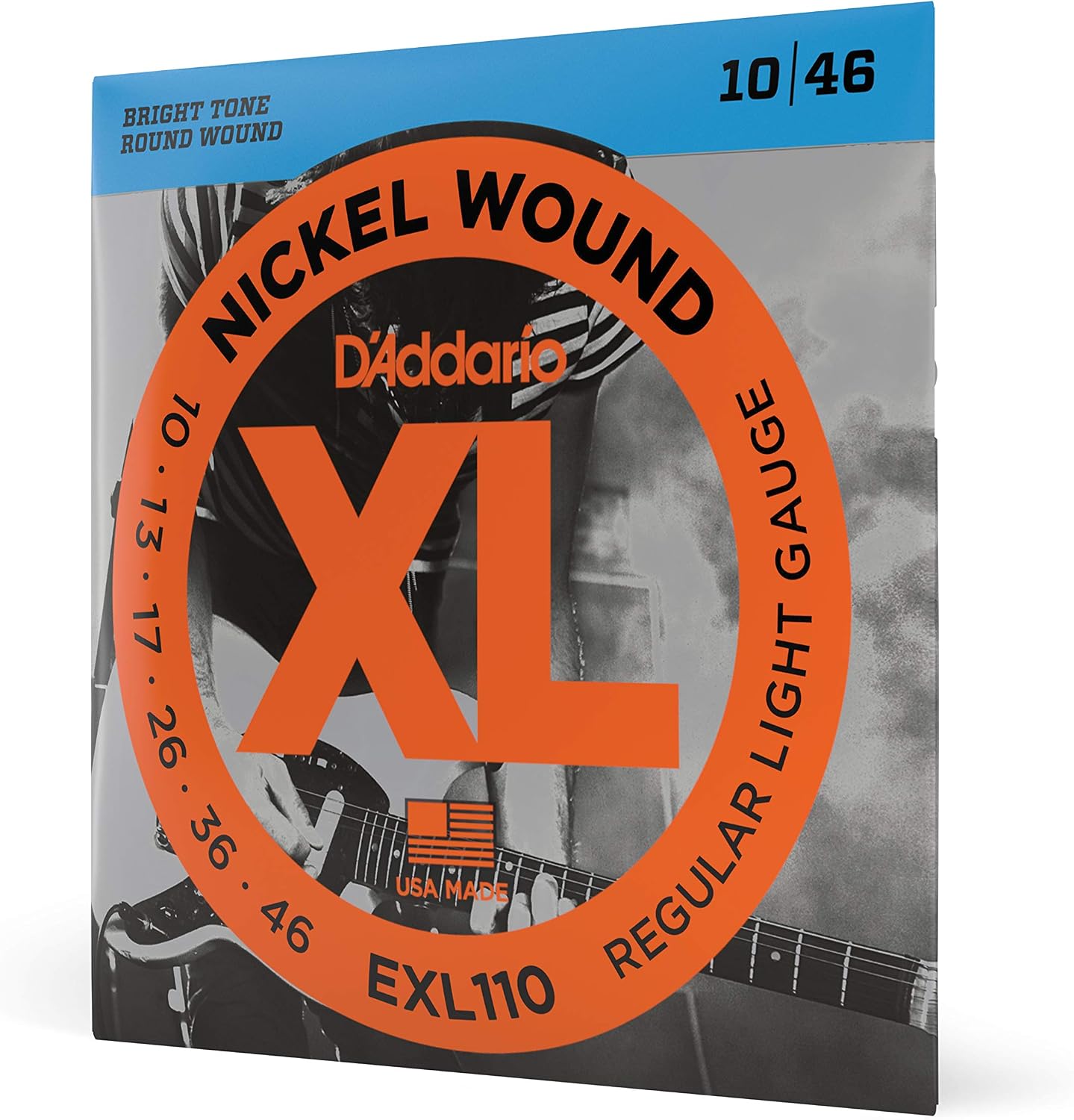
**10-46 (tens).** This is the all-rounder. Gibson fits 10-46 to its Les Pauls and SGs, and PRS uses the same gauge, so it is fair to call it the industry’s default electric set. D’Addario’s EXL110 and Ernie Ball’s Regular Slinky both sit here. Tens feel noticeably firmer than nines, stay in tune a touch better, and produce a fuller, more balanced sound, which is why so many players never move off them. If you are after a safe first electric set, best rated electric guitar strings in 10-46 are the obvious place to start.
**11s and up (11-49, 11-52, 12s).** Once you cross into elevens the strings get genuinely stiff. These sets suit heavier styles, players with strong hands, and anyone tuning down, where the extra thickness keeps the strings from going floppy. Jazz guitarists often run 12s or 13s with flatwound construction for a warm, thick tone, while blues and rock players who want maximum punch and sustain will pick 11-48 or 11-52.
What guitar string gauge does to feel and tone
The first thing gauge changes is feel, because thicker strings carry more tension at the same pitch. Lighter strings bend easily and let your fingers move fast with less effort, but they also deflect more under pressure, which can make it easy to squeeze notes sharp if you grip hard. Heavier strings push back, so bends need more muscle, but they give you something solid to dig into.
Tone follows the same direction. More metal vibrating means more output into the pickups and more low-end weight and sustain, so heavier strings tend to sound bigger and warmer. Lighter strings lean the other way, with more snap and brightness on the top end and a quicker attack. The difference is real but not night and day, and it is smaller than the difference a good amp or a pickup swap makes, so treat gauge as one flavour of the recipe rather than the whole dish.
Scale length matters here too. A Fender with its 25.5 inch scale puts more tension on a given string than a Gibson’s shorter 24.75 inch scale. The same 10-46 set will feel a touch tighter on a Stratocaster than it does on a Les Paul, which is worth remembering when you compare notes with a friend on a different guitar.
Gauge and tuning together
Gauge and tuning are two halves of the same equation. String tension depends on pitch, scale length, and thickness, so if you lower the tuning without changing the strings, the tension drops and the strings get loose and buzzy. Drop D on a 9-42 set is fine for the odd song, but a full half-step down to E flat usually benefits from stepping up to 10s, and lower still you need the thick stuff.
As a rough map, standard tuning and E flat sit comfortably on 9s or 10s depending on how stiff you like the feel. D standard and drop C want 11s or 12s to keep the tension up, and anything lower, the open tunings and the C tunings favoured by modern metal, is 12s and beyond. Seven and eight string guitars follow the same logic, adding a low B or F sharp that needs its own thicker gauge to stay tight and clear. The simple rule is this: tune down, string up.
How to pick your gauge
Start from what the guitar left the factory with. That gauge was chosen to balance the neck, the nut slots, and the pickups, so it is the safest default. Then adjust for how you actually play. If you bend a lot, play lighter styles, or find your hands tire quickly, lean lighter and try 9-42. If you play rock, blues, or pop in standard tuning and want one set that does a bit of everything, 10-46 is the obvious choice. If you tune down, play with a heavy right hand, or want the thickest possible tone, move to 11s or beyond. Let your own comfort decide, not a forum thread, because a set that fights your hands will never sound good no matter how theoretically perfect it is.
One thing to plan for when you do switch is a quick setup. A meaningful change in gauge alters the overall pull on the neck, which shifts relief, string height, and intonation slightly. A small turn on the truss rod and a check of the bridge saddles usually brings everything back in line, and a good tech can do it in minutes.
Acoustic gauges and how they differ from electric
Acoustic guitar string gauge follows the same numbering, but the sets are heavier because an acoustic needs more tension to drive the soundboard. Where an electric player might think 12s are heavy, on an acoustic a 12-53 set is a light gauge and the normal starting point.
**11-52 (extra light).** The lightest common acoustic set, easy on the fingers and suited to beginners, to guitars with a shorter scale, and to players who do a lot of bending. You give up a little volume and bottom end.
**12-53 (light).** The acoustic standard, and what ships on most new guitars. Warm enough for fingerpicking, bright enough for strumming, and comfortable for long playing. If you do not know what to buy, this is the one.
**13-56 (medium).** The heavy option, with more volume, more low end and a stiffer feel. Bluegrass rhythm players and hard strummers like them for the punch. They put more tension on the top, so they are worth building up to, and they are the wrong choice for a lightly braced vintage guitar or a small body instrument that might not take the load.
Acoustic also has its own wrinkle: a guitar’s top, bracing and bridge plate are built for a certain tension range, so jumping several gauges can overload a lightly built instrument or leave a heavily braced one sounding thin. One step either way is safe. Three or four steps needs a thought about the guitar, not just your fingers.
Gauge by genre
Players tend to land on the same few choices within a style, and knowing the conventions gives you a sensible starting point.
Blues players live on 9s and 10s, because the style is built on big bends and a light touch. Vintage blues on a Strat usually means 9-42 or 10-46, and some go lighter still for maximum bendability.
Classic and hard rock sits on 10-46 for the balance of tone and playability, stepping up to 11s for heavier riffs and fatter chords. Modern metal often uses lighter top strings and heavier bottoms, or heavier sets paired with a lower tuning, so a 10-52 or 11-56 set in drop D or drop C keeps the low strings tight while the top strings still bend for lead work.
Jazz players traditionally use heavy flatwound sets, usually 12s or 13s, for a smooth, thick, woody tone with almost no string noise. The heavy gauge helps produce the fat, rounded sound the style is known for, and the smooth winding keeps slides quiet.
Country and session players often like light gauge for bending behind the steel style and for fast, clean single note work. 9s or 10s in standard tuning suit chicken picking and pedal steel style bends.
Fingerstyle acoustic players tend to prefer phosphor bronze in a light or custom light gauge, because the strings need to respond to a soft touch while still carrying a full tone. Heavier sets can sound better under picks but less alive under fingers.
Slide players go the other way and fit heavier strings, often 13s or more, because the extra tension keeps the slide from dragging the strings out of tune and gives a bigger, more stable tone.
String tension numbers and what they mean
Every set has a total tension, measured in pounds, and it is the single most useful number behind the gauge figures. Looking at the tension is the quickest way to understand what a guitar string gauge will feel like before you buy it.
A typical 10-46 electric set pulls somewhere around 100 to 120 pounds in total, spread unevenly across the six strings. The wound strings carry more tension than the plain ones, which is why the low E feels stiffer than the high E even though both are tuned four and a half steps apart. A set of 9s might sit closer to 85 to 100 pounds, while 11s can push past 130.
Why it matters: too little total tension and the strings feel floppy, buzz against the frets and go sharp when you dig in. Too much and the guitar feels stiff, your hands tire, and the neck takes a heavier pull that may need a truss rod adjustment. The sweet spot is the tension where the guitar feels right to you, and that number changes with your scale length and tuning.
String makers publish tension charts, and they are worth a look before you switch. They show exactly how much each string will pull at a given pitch, so you can see why a 9-46 hybrid set behaves so differently from a straight 9-42.
Hybrid and balanced sets
Not every set is a straight gauge, and the hybrids are among the most useful options on the shelf.
**Light top, heavy bottom.** A 9-46 or 10-52 set keeps the top strings light for easy bending while beefing up the bottom strings for a fatter rhythm sound. This suits lead players who want comfortable bends but a chunky low end, and it is a common choice in rock and blues.
**Balanced tension sets.** Some makers, D’Addario among them, offer sets where every string is chosen to pull roughly the same tension rather than following a neat numeric ladder. The result is a set that feels even across all six strings, which many players find more predictable under the fingers, especially for alternate tunings.
**Custom gauges.** You can buy single strings and build your own set, which is what many slide and baritone players do. It takes a little maths using a tension chart, but it lets you dial in exactly the feel you want, string by string.
Hybrids are also the neat fix for a common problem: a player who likes 9s for lead but finds the low strings too slack for dropped tuning can go to 9-46 and get both.
How to tell what gauge is already on your guitar
If you have picked up a used guitar and want to know what is on it, a couple of minutes with a measuring tool will tell you.
The accurate way is a digital caliper or a string gauge tool, which measures the diameter of each string in thousandths of an inch. Measure the high E first, since that is the number sets are named by, then check the low E, because a 9-42 and a 9-46 share a high E but differ at the bottom. Read the numbers off and you will know the set. If you do not own a caliper, a best rated string gauge tool does the same job and doubles as an action ruler.
You can also work it out by feel and pitch. Slack, easy bending strings with a bright snappy tone are light. Firm, resistant strings with a big low end are heavy. And tuning up to pitch and checking the tension tells you a lot: if a 10-46 set feels unusually stiff, the guitar probably has a shorter scale.
One caution: a worn string measures slightly thinner than when it was new, because the windings get flattened against the frets over time, so a caliper reading on a used set can be a thousandth or two low. If accuracy matters, measure a fresh set.
Gauge and your setup: truss rod, intonation and nut slots
Changing gauge is more than a string swap, and the setup is where the difference shows.
The neck is held straight by string tension fighting the truss rod. Heavier strings pull the neck into more relief, which raises the action slightly. Lighter strings let the neck straighten, which lowers it. A quarter turn on the truss rod, in the right direction and a little at a time, brings the relief back. If you are not confident doing that, a tech will do it in minutes, and it is worth it.
Intonation can shift because the tension change moves where the notes land along the neck. Check each string at the twelfth fret against its harmonic and adjust the saddle if a string is sharp or flat up the neck.
The nut is the part people forget. Heavier strings may not sit freely in nut slots cut for lighter ones, and a pinched string causes tuning drift and a ping as you tune. If you move up more than one gauge, the slots may need a light file, which is a job best left to a tech unless you have the files and the confidence.
On a guitar with a floating tremolo, changing gauge changes the total string tension, so the bridge balance goes off. You will likely need to adjust the tremolo claw screws or add a spring to bring the bridge back level. On a fixed bridge, this does not apply, which is one of the quiet advantages of a hardtail. Whichever guitar string gauge you settle on, it is the setup that decides whether it plays well, so budget for that as part of any real change.
Common gauge mistakes
A few habits cause most of the trouble players have with gauge.
Assuming heavier always means better tone. Heavier strings do sound fuller, but only if you can play them. A set that fights your hands will make you play worse, and no amount of extra low end makes up for fluffed notes.
Jumping several gauges at once. Going from 9s to 12s in one move will feel like a different instrument, and you will probably hate it. Move one step at a time and give each set a week.
Mixing strings from different sets. Using whatever is lying in the drawer works in a pinch, but mismatched gauges give unbalanced tension across the neck and can sound uneven. Buy a matched set.
Forgetting the setup. Any change of more than one step should come with a truss rod and intonation check, or the guitar will feel wrong and you will blame the strings.
Judging a new gauge in the first ten minutes. New strings go through a settling period, and a heavier set takes a little getting used to. Play it for a few days before you decide.
Ignoring the guitar’s design. A vintage acoustic with light bracing, a short scale guitar, or a cheap instrument with a thin neck all have limits. Heavier strings are not always an upgrade, and sometimes the lighter set is the right answer even if the tone is a shade thinner.
What strings cost by gauge in the UK
Gauge barely affects price, but the set type does, so it pays to know roughly what you should be handing over.
Plain electric sets, whatever the gauge, usually run from about six to ten pounds, with the big brands clustered around eight. Acoustic sets are similar, and best rated acoustic guitar strings at that price cover most players. Heavier strings use a little more metal, so a 13-56 set can cost a pound or two more than the same brand’s 11-52, but it is not a big gap.
Coated sets push the price up to around eleven to eighteen pounds, and the extra is really a prepayment for lifespan. Boutique and hand-wound sets can pass twenty pounds. The steep discounts are usually on odd gauges or discontinued lines, so a bargain on a 9-46 hybrid is worth grabbing if that is your set, and a bargain on a gauge you would never play is not a bargain at all.
Multi-packs of three or four sets are the quiet saving, and if you have found your gauge, buying in bulk drops the per-set cost without changing anything about how the guitar feels.
Recommended gear
These are the sets and tools I reach for when setting a guitar up, all available on Amazon UK.
- Ernie Ball Super Slinky 9-42 rel sponsored. The classic light set, and the best first stop if you want easy bends.
- D’Addario EXL110 10-46 rel sponsored. The all-rounder’s set, reliable and easy to find anywhere in the UK.
- MusicNomad string action gauge rel sponsored. A pocket ruler for checking string height and relief when you change gauges.
Frequently asked questions
Does string gauge affect intonation?
It can, but only because it changes tension. Thicker strings pull harder on the neck, which alters relief and string height, and that shifts where the notes sit slightly. Set the guitar up for the new gauge and the intonation falls back into line. Gauge itself does not make a guitar harder to intonate, a setup issue is the real culprit.
Are heavier strings louder?
Unplugged, yes, noticeably so, because more mass drives the soundboard and air harder. Through an amplifier the effect is softer: heavier strings move the pickups a little more and sound fuller, but you will feel the difference in tone more than you will hear a big jump in volume. The amp and pickups still decide most of your output.
What gauge do most players use?
For electric in standard tuning, the vast majority sit on either 9-42 or 10-46, with 10-46 the single most common all-rounder across rock, blues, and pop. Heavier sets dominate in metal and jazz, while lighter gauges stay popular with beginners and heavy benders.
Do I need to set up my guitar when I change gauge?
Usually yes, if the change is more than one step. The neck’s relief shifts with the change in string tension, so a quick truss rod tweak and a check of the action and intonation keep the guitar playing clean and in tune. It is a few minutes’ work and well worth doing.
Can I put 10s on a guitar set up for 9s?
Yes, and it is a common move. One step up from 9s to 10s is gentle and many players do it without touching anything, though the neck will take a little more pull and the action may drop slightly. Play it for a few days; if it buzzes or feels stiff, a small truss rod adjustment sorts it. Going from 9s straight to 11s or 12s is a bigger jump and will almost always need a setup.
Do heavier strings last longer?
A little, but not as much as you might think. A heavier string has more metal and a more substantial winding, so it can hold its tone slightly longer before the grime wins, and it is less likely to break under hard strumming. But the difference is modest, and the bigger factor in string life is coating and how much your hands sweat, not the gauge.
What gauges do acoustic guitar strings come in?
The common acoustic gauges are 11-52 (extra light), 12-53 (light, and the standard), and 13-56 (medium). Twelve-string sets and some specialist bluegrass sets use heavier bottoms, and there are lighter custom sets for short scale guitars and beginners. A 12-53 set is the safe default for almost any steel string acoustic.
If you are still weighing up which guitar is right for you before you worry about strings, have a look at our guitar comparison tool.
*Disclosure: this article contains Amazon UK affiliate links. As an Amazon Associate I may earn from qualifying purchases, at no extra cost to you.*