
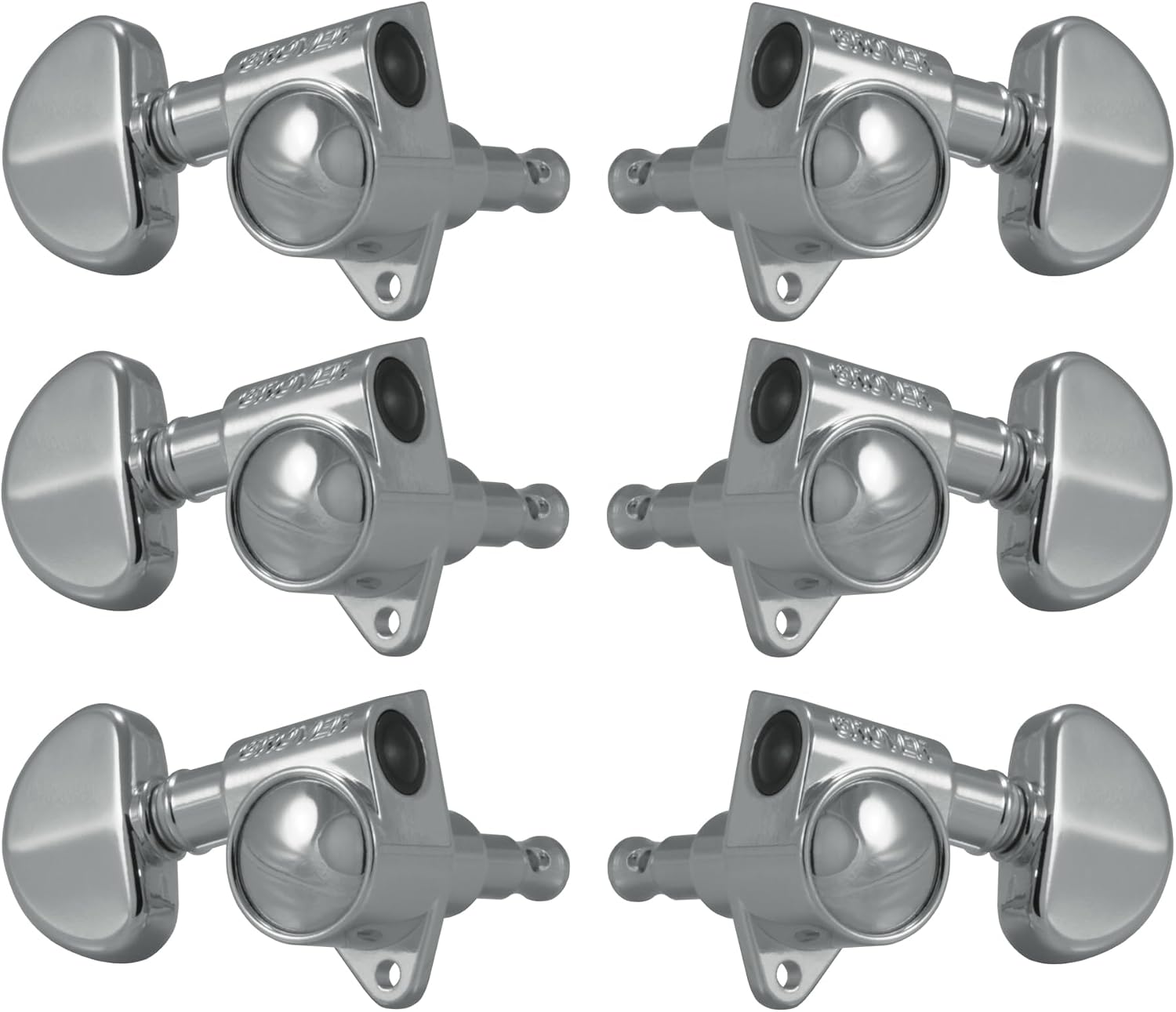
Guitar tuning pegs loose? It is almost always the collar nut on the face of the headstock working slack, not a worn gear. Hold the button, try to rock the whole housing against the wood, and see which part actually moves. In most cases a 10mm nut driver and a small clockwise turn fixes it in under two minutes.
Key Takeaways
- The collar nut on the face of the headstock is the part that comes loose. The screw on the back only holds the button on.
- Rock the housing, not the button. Movement at the face means a slack nut. Movement in and out means the button screw or thrust washer.
- If the button rotates backwards when you bend a string, the gear is worn and no amount of tightening will save it.
- A guitar that goes sharp after bending is usually a binding nut, not a loose tuner. Check that before you touch any hardware.
- Snug is tight enough. Overtightening the collar nut cracks the finish and crushes the wood under the washer.
What loose guitar tuning pegs actually means
Most of what gets called guitar tuning pegs loose is one of three faults. The button wobbles on its shaft. The whole tuner rocks against the headstock. Or the guitar will not hold pitch and the tuners get blamed. Each has a different fix, and only one is a genuinely loose peg.
A machine head has five parts that matter: the button your fingers turn, the post the string wraps around, the gear housing on the back of the headstock, and the collar nut and washer that clamp that housing to the face. On older designs two or three small screws do the same job.
Sealed tuners and open gear tuners are not the same job
Almost every guitar built after 1980 uses sealed die-cast tuners, with the gear inside a closed housing and nothing to adjust. The only fasteners are the collar nut on the face and the small screw on the back of the button. If the gear is worn, the unit is scrap.
Vintage pattern tuners, the Kluson Deluxe style and its copies, have an exposed cog and a small tension screw. That screw sets how tightly the gear teeth mesh. It is also the screw people overtighten until the tuner feels stiff and grinds.
The four checks that find the loose part in two minutes
Check one: rock the housing. With the strings at pitch, pinch the button so it cannot turn, then rock the whole tuner body up and down against the headstock face. Any movement, or a click, is a slack collar nut. This is the common one.
Check two: push and pull the button. A tiny amount of end float, under half a millimetre, is normal on a worn tuner. A visible in and out clunk means the button screw is loose or the thrust washer behind the button has worn through.
Check three: the tape test. Tape a line across the headstock onto the button, bend the string hard, then let it back. If the line on the button has moved, the gear is slipping. That is a worn cog, and it is the one fault a spanner cannot fix.
Check four: rule out the nut. Tune, bend, release, then check the pitch. If it comes back sharp, the string is sticking in the nut slot and releasing slowly. The tuners are innocent. Work through why your guitar keeps going out of tune before you spend anything.
The decision table
| What you find | What is actually loose | The fix |
|---|---|---|
| Whole tuner rocks against the headstock, or rattles and stops when you touch the button | Collar nut on the face | Tighten the collar nut an eighth of a turn at a time |
| Button wobbles, in and out play along the post | Button screw, or the thrust washer behind the button | Tighten the back screw. If the play remains, replace the tuner |
| Button turns backwards under a bend, tape mark moves | Worn cog or worm gear | Replace the machine head |
| Comes back sharp after a bend, tuner feels solid | String binding in the nut slot | Lubricate the slot, or have the nut slotted correctly |
| Tuner lifts off the headstock face, moves sideways | Mounting screws loose or stripped (vintage pattern) | Tighten, or plug the hole with glued hardwood and refit |
| Post leans, string jams at the post, guitar has been dropped | Bent post | Replace the machine head. A bent post cannot be straightened safely |
| Rattle only on certain notes, no movement anywhere | Loose string end, truss rod cover screw, or a washer | Trim the string ends, check every screw on the headstock |
Guitar tuning pegs loose on a sealed tuner: how to tighten them
You need a 10mm nut driver, or a 10mm socket on a small handle. Do not use pliers and do not use an adjustable spanner. The collar nut is thin and often chrome plated, and both of those tools round the corners off it.
- Detune the string on that tuner until it is slack. You do not have to remove it.
- Hold the button so the tuner cannot spin, and fit the nut driver over the collar nut on the face of the headstock.
- Turn clockwise until it stops, then a sixteenth of a turn more.
- Check the rock test again. If it still moves, repeat in small steps.
- Retune and check the string still passes cleanly through the nut slot.
There is no torque figure for this. The washer needs to be compressed against the wood, not crushed into it. If the nut comes back loose within a few weeks, the wood under the washer has compressed into a dish and the tuner needs a thicker washer or replacing.
A driver set with the correct bit for each size saves grief. The MusicNomad 26 piece guitar tech screwdriver and wrench set covers the 10mm nut, the Phillips sizes for the back screws and the small flathead for vintage tension screws in one case.
On a vintage open gear tuner
Check the mounting screws on the back plate first, because they hold the tuner to the headstock and they work loose on old guitars. Then the small tension screw on the cog. A quarter turn clockwise at most, and stop when the gear stops rocking. Beyond that the tuner gets stiff and the teeth wear faster.
On a slotted headstock classical
Rollers are held by two screws per side plus a screw at the end of each roller, and loose ones rattle and slip. Tighten the end screw first, then the plate screws. Do not overtighten the end screw, because the roller is soft timber on cheaper instruments and the thread strips easily.
Which screw does what
The screw on the back of the button feels like the obvious loose one, and on a sealed tuner it does nothing except hold the button on.
| Fastener | Typical size | What it holds | What happens if you overtighten |
|---|---|---|---|
| Collar nut (face of headstock) | 10mm across flats on most sealed tuners, 25/64 in. A few are 9mm | Clamps the gear housing to the headstock | Cracks the finish around the washer, crushes the wood, can split the headstock veneer |
| Bushing or ferrule | Press fit, 8.7mm (11/32 in) on vintage pattern | Centres the post in the hole | Pushes through and splits the face of the headstock |
| Button screw (back) | Phillips PH1, or 2mm hex on locking types | Holds the button on the shaft only | Strips the thread in the shaft, and the button falls off mid gig |
| Gear tension screw (vintage only) | Small flathead, 2mm to 3mm | Sets how tightly the cog and worm mesh | Binds the gear and wears the teeth out faster |
| Mounting screws (vintage pattern) | Phillips PH1, two or three per tuner | Holds the back plate to the headstock | Strips the screw hole in the wood, then the screw spins and will not hold |
How to tell a worn gear from a loose nut
Backlash is the play between the gear teeth before anything moves. Hold the button still and try to turn the post by hand with the string slack. A degree or two is normal. A quarter turn of free movement before the gear bites means the teeth are worn.
Two more signs. The button feels notchy, with a tight spot and a loose spot in the same revolution. Or the pitch changes in jumps and you hear a click at the post. Once a sealed tuner does either, replacement is the only option, because there is no adjustment inside the housing.
On old open gear tuners you have one more option: clean the hardened grease out of the cog with a cloth and a little naphtha, then apply a drop of light machine oil. Never WD-40, which collects dust and turns into grinding paste.
When tightening will not fix it
Replace the machine head if any of these are true.
- The tape test shows the button rotating backwards under tension.
- The post is bent, or the string jams against the post when you tune up.
- The button has snapped off. Pot metal tuners on cheaper guitars fail at the button, and no glue holds a loaded tuner.
- The collar nut will not stay tight because the wood under the washer has compressed.
- The mounting screw holes are stripped and a screw will not hold at all.
- There is a visible in and out clunk at the button that tightening the back screw does not remove.
Fitting a replacement set without wrecking the headstock
Match the pattern before you order
Three things have to match: the number of tuners per side, so 3+3 on a Les Paul or acoustic and 6 in line on a Strat, the post hole size, and the screw hole pattern on the back. The last one is where people come unstuck, because a modern Rotomatic pattern does not line up with the old Kluson holes. Buy a set that matches, or fit an adapter plate. Do not drill four new holes to make a £40 set fit, because that costs far more than £40 at resale.
Hole sizes and conversion bushings
Modern sealed tuners need a 10mm (25/64 in) hole. Vintage Kluson pattern tuners use an 8.7mm (11/32 in) hole with a press fit bushing. Fitting modern tuners into a vintage hole needs conversion bushings, which are cheap and widely available. Going the other way, vintage tuners into a modern 10mm hole, needs the hole bushed down, and that is a job for someone with a drill press and the right reamer.
The job in order
- Take the strings off and note which way each tuner faces. Photograph the headstock before you start.
- Remove the old tuners, keeping the screws in a pot by tuner number, because they are rarely interchangeable.
- Clean the old washers and any compressed finish out of the holes.
- Test fit one tuner without screws. The post should pass through with no force. If it needs force, the hole is undersized and needs reaming, not hammering.
- Fit the collar nut and washer finger tight, align the housing square to the edge of the headstock, then fit the mounting screw.
- Tighten the collar nut to snug, then the mounting screw. Do not overtighten the screw, because that is what strips the hole.
- Fit the rest, restring, bring to pitch, then recheck every collar nut after the first tune up, because the wood settles under load.
For the stringing side, see how to change guitar strings. A winder makes the last stage quicker and keeps tension even across the posts, and the Planet Waves Pro-Winder is the one most techs keep in a pocket.
Which replacement tuners to buy
| Type | Post hole | Gear ratio | Fixing | Typical UK price, set of six | Best for |
|---|---|---|---|---|---|
| Modern sealed die-cast, Grover Rotomatic 102 style | 10mm | 18:1 | Collar nut plus one screw | £70 to £85 | Most electrics, and a big upgrade on budget guitars |
| Vintage open gear, Kluson style | 8.7mm press fit | 14:1 to 15:1 | Two or three screws | £40 to £60 | Older guitars where you do not want to drill |
| Locking sealed, Grover Roto-Grip or similar | 10mm | 18:1 | Collar nut plus one screw | £30 to £100 | Faster string changes, tremolo use |
| Mini sealed, Grover 406 style | 10mm | 18:1 | Collar nut plus one screw | £60 to £70 | Smaller headstocks, six in line |
| Classical roller and plate | Not applicable | 14:1 | Two screws per side | £25 to £50 | Nylon string guitars |
Gear ratio is the number of turns of the button it takes to turn the post once. A 14:1 tuner moves the pitch faster and feels coarser. An 18:1 feels smoother and makes small corrections easier, which is why it is the standard on anything decent.
For a straight replacement on a guitar with 10mm holes and a modern pattern, the Grover 102-18C Rotomatic set in chrome is the safe choice. It is 18:1, three per side, and it has been the default upgrade for forty years for the simple reason that it fits and it lasts.
If you want locking heads on a budget, the Guyker locking tuners, 3 plus 3, 1:18 are about a third of the price and fine on a gigging guitar that lives in a case. On a guitar worth more than a thousand pounds I would fit the Grover 502CK Roto-Grip locking set instead, because the gears are better machined and the collar nuts do not work loose.
Does changing tuners change the tone?
Not in any way you will hear in a blind test. Tuners hold the string at pitch, they are not in the signal path, and they do not add sustain whatever the marketing says. What changes is the weight at the headstock and the feel of tuning. The honest reason to replace them is stability and feel.
What it costs in the UK
| Job | What is involved | Typical UK cost, 2026 |
|---|---|---|
| Tighten a collar nut yourself | 10mm nut driver, two minutes | Nothing if you own the driver, around £16 for a nut driver set |
| One replacement machine head | Match the pattern, fifteen minutes | £12 to £20 for a single, £30 to £85 for a full set |
| Fitting a full set at a shop | Check holes, align, fit, restring | £30 to £60 labour |
| Plug and redrill a stripped screw hole | Hardwood plug, glue, pilot hole | £20 to £40 labour, or a toothpick and wood glue at home |
| Repair a cracked headstock | Glue, clamp, touch in the finish | £60 to £150 |
| New nut, when it was never the tuners | Bone or synthetic blank, cut and slotted | £35 to £60 |
| Full setup after fitting | Relief, action, intonation | £45 to £70 |
That last line matters. New tuners change the break angle over the nut slightly, and a guitar set up on the edge of a buzz will start buzzing. Check it using how to set up a guitar before you blame the new tuners.
When to stop and see a guitar tech
Stop if the collar nut turns but never tightens, which means a stripped thread or compressed wood. Stop if there is a crack running out from a tuner hole, because tightening it further opens the crack. Stop if the hole is visibly oval, because that needs bushing, not a bigger washer.
Also stop if the four checks have not told you which part is loose. Guessing with a spanner is how a two minute fix becomes a headstock repair.
Frequently Asked Questions
Can I tighten loose tuning pegs with the strings still on?
Yes. Detune that string until it is slack, hold the button so the tuner cannot spin, and tighten the collar nut with a 10mm nut driver. Leave the other strings at pitch, because a tuner that feels tight with no load can still slip under tension.
What size is the nut on a guitar tuner?
Most modern sealed tuners use a 10mm collar nut, which is 25/64 inch. A few are 9mm, and vintage press fit bushings are 8.7mm, or 11/32 inch. Measure across the flats before you apply force, because a 10mm driver on a 9mm nut rounds it off.
Should I use pliers or an adjustable spanner on a tuner nut?
No. Both round the corners off a thin chrome nut, and once the flats are gone you cannot tighten it without damaging the tuner. A 10mm nut driver or a six point socket costs a few pounds.
Why do my tuning pegs feel loose but the guitar stays in tune?
Because the looseness is in the button or the washer, not the gear train. Slight side to side play is normal on a worn tuner and does not affect tuning. If the guitar holds pitch through a gig, the wobble is cosmetic.
Why is my guitar rattling near the headstock?
Check the collar nuts first, then the string ends at the posts, then the truss rod cover screws. A slack collar nut buzzes and stops the moment you rest a finger on the button. Loose string ends and cover screws rattle constantly.
Do loose tuning pegs make a guitar go out of tune?
Only if the gear is slipping. A loose collar nut lets the housing rock, which changes the string angle and can shift pitch slightly, but the usual cause of a guitar that will not stay in tune is a string binding in the nut slot. Test that first.
How tight should a tuner collar nut be?
Snug, plus about a sixteenth of a turn. The washer needs to sit flat against the headstock with no movement, and that is all. There is no factory torque figure. If you can see the finish has cracked in a ring around the washer, you have gone too far.
Can I fit locking tuners to any guitar?
Almost always, provided the post hole size and the number of tuners per side match. Locking sets come in 3 plus 3 and 6 in line, in 10mm, with conversion bushings for vintage holes. The screw pattern may need an adapter plate rather than new holes.
Can I fix a stripped tuner screw hole with glue?
Yes, and it works well. Push a cocktail stick dipped in wood glue into the hole, snap it off flush, let it cure, then refit the screw. For a hole that has gone oval, drill it out, glue in a hardwood plug and start a fresh pilot hole.
My tuning peg snapped off. Can it be repaired?
No. The button is pot metal or cast alloy on most tuners, and a snapped shaft cannot be glued or welded with any reliability under string tension. Replace the single machine head, matching the pattern and the post height, which is cheaper than a full set and keeps the guitar original.
Related guides
- Why your guitar keeps going out of tune
- How to tune a guitar
- How to change guitar strings
- Why guitar strings keep breaking
- How to set up a guitar
- Guitar action too high
- Compare recent sold prices for your guitar
As an Amazon Associate, I earn from qualifying purchases. Links on this page are affiliate links, marked with rel=”sponsored”.