
The short answer to how to store a guitar is simple: keep it in a case, or on a solid stand or wall hanger, hold the surrounding air at a steady 40 to 60 percent humidity, and keep it out of direct sunlight. Get those three right and most storage damage never happens. A guitar is tougher than it looks, but it is wood, and wood reacts to its surroundings. A neck can bow, a top can sink, and frets can feel sharp, all without a single knock. Here is what to do day to day, what to do when the guitar goes away for months, and how the answer changes with the season and with the kind of guitar you play.
Short-term storage: case, stand or hanger
For a guitar you play most days, the aim is to keep it within reach without leaving it at risk. The three normal options are a case, a floor stand, and a wall hanger.
A case is the safest. It protects against knocks, pets, and sudden swings in temperature and humidity. The trade-off is convenience: a guitar you have to unlatch every time tends to get played less.
A floor stand keeps the guitar upright and off the floor, which is the bare minimum. A cheap A-frame stand is easy to catch with your foot, and the guitar can topple if someone knocks the neck. Put it out of the walkway. A stand with a neck yoke, the kind that grips just under the headstock, is a better buy than a plain tripod, because the guitar cannot fold forward when a strap gets snagged.
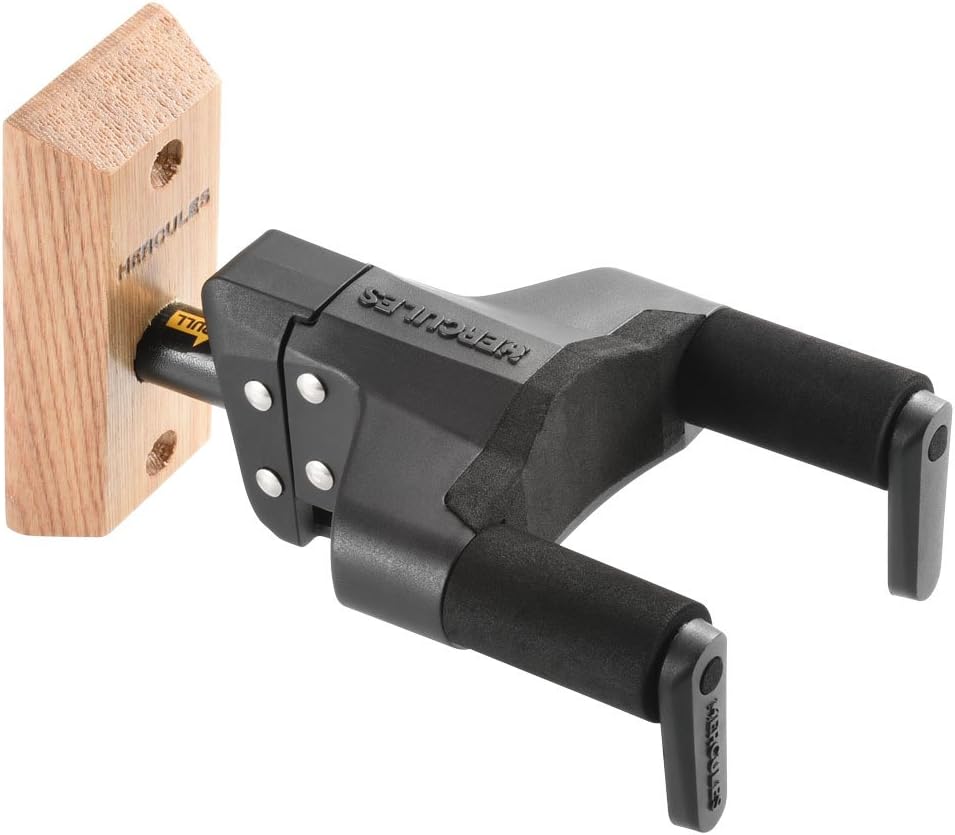
A wall hanger gets the guitar up and out of harm’s way. A hanger fixed into a stud is one of the safest ways to keep a guitar out and ready, and it frees floor space at the same time.
Whatever you choose, never lean the guitar against a wall, a sofa, or an amp. That is how headstocks get snapped and necks get warped. If a guitar has to sit somewhere for ten minutes, lay it flat on a table or in a case rather than propped up on its end.
Long-term storage: prep before you pack it away
Putting a guitar away for months is not the same as resting it on a stand overnight. A little preparation now saves a warped neck and a setup bill later.
First, slack the strings. You do not need to take them off, but drop the tension by roughly a full tone to a tone and a half. At pitch the strings pull well over a hundred pounds of tension on an acoustic, and leaving that on for months is the fastest way to bow a neck or lift a bridge. Slackening them takes the strain off the wood while keeping enough load to hold the neck’s shape. Tune down rather than stripping the strings off completely, because a neck with no tension at all can settle into a back bow of its own.
Second, clean it. Wipe the strings, fretboard, and body with a soft cloth to remove sweat and skin oils, which tarnish frets and corrode strings. A light fretboard conditioner on a rosewood or ebony board stops it drying out. Leave a maple board alone, because maple is usually finished and oil will sit on the lacquer rather than soak into the wood.
Third, case it with a humidifier. Central heating can drop indoor air well below the 40 to 60 percent range a guitar likes. A simple soundhole humidifier, or a couple of humidifying pouches, keeps the wood stable. Put the case somewhere with a steady temperature and never against a radiator, in a loft, or against an outside wall.
Finally, drop a slip of paper with the date into the case pocket. If the guitar ends up sitting there for a year, you will want to know when you last looked at it, and a note makes the monthly check a habit rather than a guess.
The enemies: heat, dryness and damp
Most storage damage comes down to three things, and none of them is a knock.
Heat is the one people underestimate. A guitar in a car boot, a conservatory, or a loft in summer can sit in temperatures that soften glue and warp the top, and the bridge can lift clean off. If you would not want to sit in that room in a jumper, your guitar does not want to be there either. Anything above about 30 degrees Celsius for days on end is a risk, and a sunlit car boot will pass 50 without trying.
Dryness is the slow killer. Below about 40 percent humidity the wood shrinks. The top can sink, the neck can back bow, fret ends can poke out, and the finish can develop fine cracks. That is why a humidifier matters, and why it matters most from October through to March when the heating is on.
Damp is the opposite and just as destructive. Above about 60 percent humidity the wood swells, strings go dull, and you risk rust, mould, and a swollen top. A cheap digital hygrometer tells you which of the three you are up against. A reading twice a week is enough to catch a problem long before it gets expensive.
Wall hanging done right
Hanging a guitar on the wall is completely fine, provided you fix the hanger correctly and hang it in a sensible place.
Screw the hanger into something solid. Go into a stud, or use a heavy-duty fixing rated well above the guitar’s weight. Plasterboard on its own will not hold, and when a hanger rips out it takes the guitar with it. A hanger in a stud with a decent screw will carry many times the weight of any guitar you own.
Hang it where the environment is stable. An interior wall is better than an outside one, which can turn cold and damp. Keep it out of direct sun, away from radiators, and away from heater or fire draughts. Mind what is above and below too: not over a radiator, not over a slamming door, and not where a shoulder will clip the headstock.
One note on finishes. The rubber cradle on a cheap hanger can mark a nitrocellulose finish over time, so a wrap of cotton cloth around the cradle removes the doubt. If your guitar has a modern polyester finish, which most budget and mid-range instruments do, this is far less of a worry.
How to store a guitar through the seasons
The rules are the same all year, but the risk changes with the calendar, and in the UK the danger points are predictable.
From October to March, the heating does the damage. Outside air on a British winter day is often 80 percent humidity or more, but warm that air in a house and the relative humidity collapses, commonly down to 25 or 30 percent in a heated room and lower still overnight. That is the window when tops sink, fret ends sprout, and hairline cracks appear along the centre seam. If your guitar lives in a heated room, this is when the case and the humidifier earn their keep.
In summer, heat and damp swap places. An unshaded room can hit 30 degrees and stay there, and a loft or conservatory goes far higher. Wood swells above 60 percent humidity, so the top bellies up, the action creeps higher, and the glue at the bridge does its quietest work. Keep the guitar out of the sun and away from windows, and if the room is damp, a couple of silica packs in the case will pull the worst of it down.
Spring and autumn bring the big swings, warm days and cold nights, heating on one week and off the next. Wood does not crack because it is dry so much as because it is moving, so a stable 45 percent all year beats a perfect 50 percent that lurches around. That is the single most useful idea in this whole article, and it is why a cheap hygrometer beats an expensive guess.
Storing by guitar type: acoustic, electric, classical and bass
Not every guitar needs the same treatment, and knowing where yours sits saves you effort and money. How to store a guitar is never one answer, because a solid body electric and a thin topped acoustic want quite different things.
A solid wood acoustic with a spruce or cedar top is the one to worry about. The top is thin, it is braced and under string tension, and it moves more with humidity than any other part of any guitar. It wants the humidity held in range, a hard case for anything more than a night away, and a look at the fret ends every few weeks through winter.
A laminate acoustic, where the top is made of layered wood rather than one solid sheet, is far more stable. Plenty of guitars have a solid top with laminate back and sides, and those behave much like a solid instrument for humidity purposes, so check the spec rather than the price tag. A fully laminate guitar rarely cracks, but its neck and fretboard still shrink in dry air.
A solid body electric is the toughest of the lot. It is a thick slab of wood with a hard finish, and there is no thin braced top to split. What it does suffer from in dry conditions is a moving neck and fret ends that sprout over the edge of the fingerboard, and what it suffers from in damp is corroded hardware and a finish that goes cloudy. Store it in a case or on a hanger in a normal room and it will be fine. Do not leave a nitro finished guitar in a soft case for months, because the plasticisers in some cheap case linings react with the paint.
A hollow body or archtop sits in between. The body is laminated on most mass produced ones, but the top is still thin enough to move, and the f holes make it awkward to humidify from the inside. Keep these in a hard case with a case humidifier rather than a soundhole one.
A classical or nylon string guitar has lower string tension, so it is kinder on its neck, but its top is just as vulnerable to dry air as any steel string, and a french polished finish marks easily. Store it in a hard case and keep the humidity up.
A bass, with its long scale and heavy strings, puts the most load on the neck of anything here. A bass that dries out will move, and a change in relief that would be harmless on a guitar can shift the action noticeably on a 34 inch scale. If you store a bass long term, slack the strings and keep it in a case.
Measuring the room: hygrometers, thermometers and placement
Knowing how to store a guitar starts with knowing what the air in the room is actually doing. You cannot manage what you cannot measure, and a best rated hygrometer costs less than a set of strings. Buy one, then buy a second if you keep guitars in two rooms.
Placement matters as much as the reading. A hygrometer on a shelf tells you about the shelf, not about the case. Put one on the wall of the room the guitars live in, and put a small one inside the case if you are humidifying, because the case is a different climate to the room. A case with a humidifier can sit at 50 percent while the room around it is at 30.
Cheap digital meters are often out by several percent, which matters when the safe band is only twenty points wide. You can check one with a salt test. Put a spoonful of table salt in a small dish, add a few drops of water so it is damp but not dissolved, seal the dish and the hygrometer together in a plastic bag, and leave it for eight hours. A meter that reads 75 percent is accurate. One that reads 65 is ten points low, and you can either correct for it in your head or replace it.
A thermometer earns its place too. Temperature and humidity are linked, and warm air that has not gained any moisture is drier in relative terms than cool air that has. That is why the same room reads comfortable in the morning and dry by the evening once the heating has been on for hours.
Case or gig bag: what each one is actually for
A hard shell case is the answer for storage and for any journey you did not plan. It holds its shape, resists a knock, and once closed gives a humidifier a small sealed space to work in. The cost is space and weight.
A gig bag is a carrying device, not a storage device. It is fine for a trip to a rehearsal, and fine for a guitar you play every day and put straight back on its stand, but it offers almost nothing against a knock, a boot lid, or a week in a cold room. A humidifier inside a soft bag does little because the air leaks straight out. If you have one guitar and one bag, buy a cheap hard case before the winter arrives.
For anything that travels by plane, whether in the cabin or in the hold, you want a hard case, and a flight case if you can borrow or hire one. If a guitar must go in the hold, slack the strings by a tone, pad the headstock area with something soft, and pack the case so it cannot rattle around inside a larger bag.
Transport and gigging: moving a guitar without damage
A guitar usually gets damaged in the ten minutes around a journey, not in the journey itself. How to store a guitar at home is one half of the job, and how to move it is the other, and the second is where most of the real damage happens.
When you bring a cold guitar indoors, leave it in the case to warm up before you open it. Twenty minutes does for a short trip, and half an hour or more if it has been in a cold car overnight. Open a freezing case in a warm room and the guitar fogs over, and on a nitro finish that sudden condensation is how you get a web of fine cracks in the lacquer. The same goes for a guitar delivered by courier: let the box come to room temperature, then the case, then the guitar.
When you carry a guitar, carry it in the case with the latches done up, not by the neck and not swinging it against a doorframe. In a car, put it on the back seat or in the boot in its case, never loose in the footwell where a passenger’s feet will find it, and never in the boot of a hatchback with the parcel shelf pressing down on it.
A gigging routine is worth having. Case closed between sets, guitar never left leaning on an amp or a chair, and the case never parked where somebody will put a drink next to it. Most of what looks like bad luck in a band van is really just a guitar put down in the wrong place for three minutes.
When storage damage has already happened
Some problems can be reversed at home, and some cannot, and knowing which is which saves money. By this point you know how to store a guitar better than whoever let this one dry out.
A guitar that has dried out, with sharp fret ends and a sunken top, can often be brought back by putting it in a case with a humidifier and raising the humidity slowly, over a fortnight rather than a weekend. Buy the best rated guitar humidifier packs and take your time, because wood reacts to moisture slowly and unevenly. Bring it up fast and you risk the finish and the glue joints.
A lifting bridge, a crack along the top, or a loose brace is a repair, not a storage fix, and no amount of humidifying will close it. Take it to a technician. In the UK, a bridge reglue typically runs from about £60 to £120, a cleated top crack from around £50 to £100 depending on length, and a brace reglue in a similar range. A neck reset, which is the answer when the action will not come down and the saddle is already low, is a bigger job at several hundred pounds on an acoustic with a glued in neck. That is why it pays to protect the guitar in the first place.
If a guitar has been left somewhere damp and the hardware has rusted, the fix is cosmetic for the most part. Rusty strings mean new strings. Rust on the tuners, bridge, or pickup poles can be lifted with a little fine wire wool on the metal parts, keeping the wool well away from the wood and the finish.
Recommended gear
A few things are worth owning, whatever your budget. As an Amazon Associate, I earn from qualifying purchases.
To hang a guitar safely, a String Swing guitar wall hanger is the classic choice. It screws into a single stud and has a cradle that treats the finish gently.
For keeping a guitar ready on the floor, a Hercules GS414B floor stand grips the neck so the guitar cannot topple forward, and folds flat when you want it out of the way.
For long-term storage, a Gator hard shell guitar case seals against cold and dryness and takes a knock better than any gig bag.
For anything that lives in a hard case through winter, a best rated case humidifier keeps the air around the wood in range.
Frequently asked questions
Is it OK to hang my guitar on the wall?
Yes, in almost every case. A wall hanger does not hurt the neck or the finish, and a guitar hanging by its headstock is under no more strain than one lying in its case. The two things that matter are fixing the hanger into a stud rather than bare plasterboard, and keeping the guitar away from direct sun, radiators, and outside walls.
Should I loosen the strings for long-term storage?
Yes. If the guitar is going to sit unplayed for a month or more, slack the strings by roughly a tone to a tone and a half. It relieves the constant pull on the neck and bridge while keeping enough tension to hold the neck’s shape. You only need to go further than that for a very long lay-up or shipping.
Can I store a guitar in the garage or loft?
Only if you can control the environment, which most garages and lofts cannot. Both swing between freezing and roasting across the year, and both can be damp. That combination warps necks and lifts bridges faster than almost anything else. If you have no other option, keep the guitar in a hard case with a humidifier and check the temperature range first.
Do I need a humidifier for my guitar in the UK?
If you store your guitar in a centrally heated room through winter, yes. Radiators drive indoor humidity well below the 40 to 60 percent range a guitar likes, and dry wood is where cracks and sharp fret ends come from. A cheap soundhole humidifier or a couple of case pouches is all it takes.
Can I store a guitar in a gig bag?
Mostly no, and not for longer than a trip to a rehearsal. A gig bag does not hold its shape, does not seal, and will not protect the guitar from a knock or a cold room. If a gig bag is all you have, keep the guitar on a stand in a stable room for daily playing and pick up a cheap hard case before winter.
How often should I check a stored guitar?
Once a month is enough for a guitar in a hard case in a stable room, and once a week through the heating season if you have a humidifier running. Open the case, read the hygrometer, glance along the fret ends and the top, and check that nothing has been left sitting on the strings.
Will a guitar crack if I leave it out of its case?
Not overnight, and probably not in a normal room in summer. But a guitar left on a stand next to a radiator through a British winter is the classic way to end up with a cracked top. Out of the case is fine if the room is stable and the heating is not drying the air out.
If you are weighing up whether to repair, upgrade, or sell, start by checking what your guitar is actually worth on our compare guitars page.
*As an Amazon Associate, I earn from qualifying purchases. Links on this page are affiliate links, marked with rel=”sponsored”.*