
Learning how to tune a guitar is the first real skill every player needs, and it comes down to one thing: setting the six strings from thickest to thinnest to E, A, D, G, B and E. That is EADGBE, and remembering it is the single most useful thing in this guide.
A guitar will not keep itself in tune. Strings stretch as you play, the tuning pegs settle, and a change in room temperature is enough to nudge a string flat. The result is that a beginner playing an out-of-tune guitar sounds worse than they actually are. The good news is that tuning takes about a minute once you know how, and you need no musical training to do it.
Standard tuning explained
Standard tuning is EADGBE, read from the thickest string to the thinnest. The thickest string is the low E, the sixth string, and the thinnest is the high E, the first string. When you hold the guitar in playing position, the thickest string is the one closest to your face.
The easiest way to remember the order is a mnemonic, one letter per string. The classic one is “Eddie Ate Dynamite, Good Bye Eddie”, which runs E-A-D-G-B-E from thickest to thinnest. If that does not stick, “Elephants And Donkeys Grow Big Ears” does the same job.
It also helps to know that “flat” means a note is too low and “sharp” means too high. A flat string gets tightened to raise the pitch, and a sharp string gets loosened to bring it back down.
Tuning with a clip-on tuner
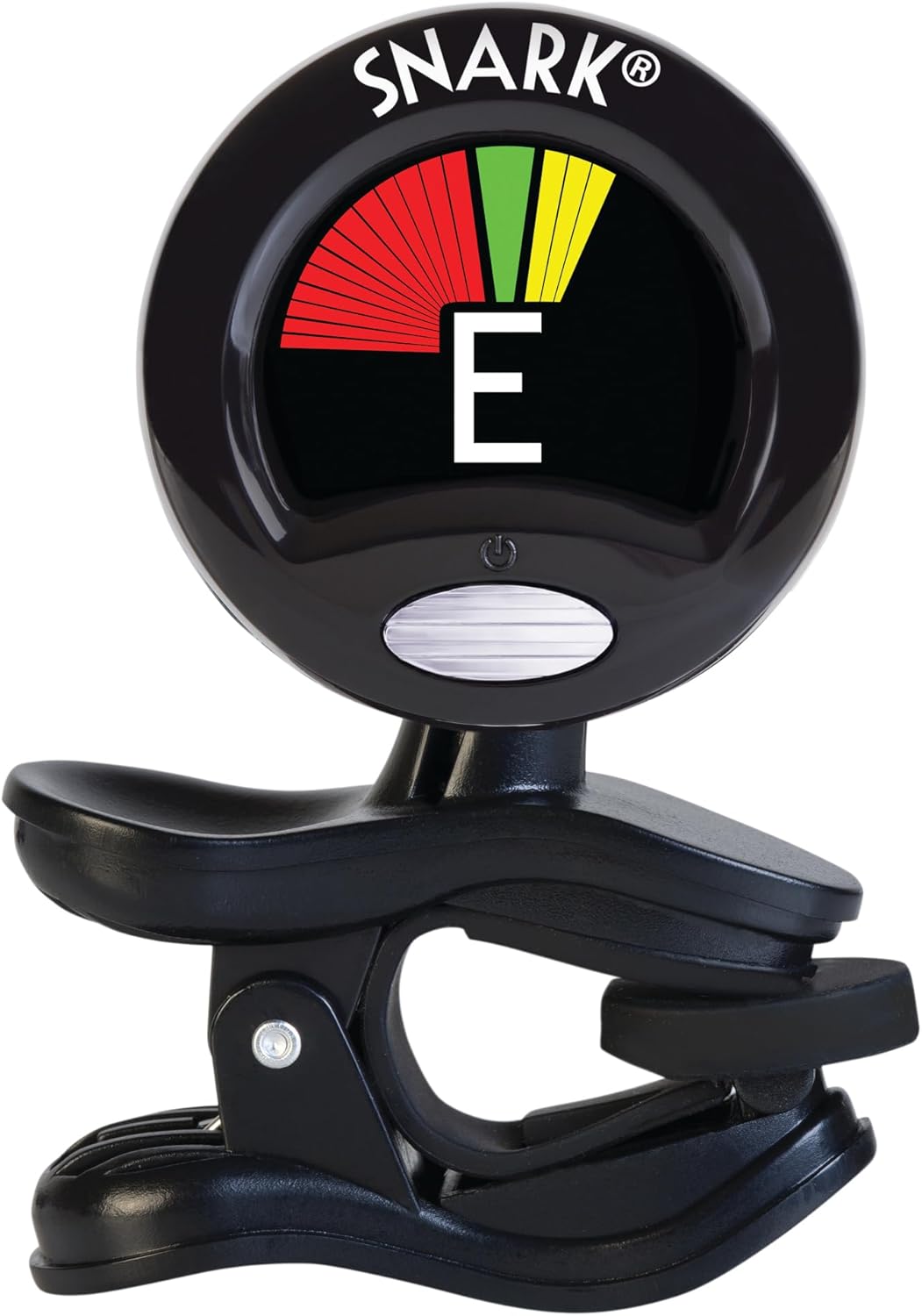
A clip-on tuner is the fastest and most reliable way for a beginner to tune. Clip it onto the headstock, the flat part at the end of the neck where the tuning pegs live, and it reads the vibration of the wood directly. That matters, because it works in a noisy room where a phone microphone would struggle.
Start with the thickest string and work towards the thinnest. Pluck the low E and the tuner shows the note it thinks you are playing and how close you are. Most tuners light up green when you are spot on, and show flat or sharp arrows when you are not. If it reads E but points flat, turn that string’s peg a little to tighten it and pluck again. Keep going in small movements until it settles on green, then move to the A string and repeat.
Always finish by tightening up to the note rather than loosening down to it. If you overshoot and land sharp, loosen slightly past the target and tighten back up. This keeps the tension consistent, so the string is less likely to slip flat a moment later.
Tuning by ear (the 5th fret method)
Tuning by ear uses one string you trust as a reference and matches every other string to it. Holding a string down at a certain fret produces the same note as the next open string, so you can play the two together and listen for them to blend.
The pattern is the fifth fret for almost every string. Press the thickest string at the fifth fret and pluck it, and you get an A, the note the next open string should play. Play the two together and tune the open A string until the sound stops wobbling. A fast “wah-wah” pulse means they are out of tune; as you get closer the pulse slows until the notes lock together.
Work your way across the neck the same way. Fifth fret of the A string gives D for the open D string. Fifth fret of the D string gives G for the open G string. Then the one exception, because the gap between G and B is one fret shorter than the rest: press the G string at the fourth fret to get B, and tune the open B string to that. Finally, the fifth fret of the B string gives the high E for the thinnest string.
The only catch is that your reference string has to be right, or you will be perfectly in tune with a wrong note. If you have any tuner at all, set the low E with it first, then do the rest by ear.
Drop D and alternate tunings
Drop D is the most common variation on standard tuning. You take the thickest string down a whole step from E to D, so the guitar reads DADGBE instead of EADGBE. The easiest way to hit it is to fret the thickest string at the seventh fret and tune it down until that note matches the open A string next to it.
Guitarists use drop D because it makes power chords easier. With the two lowest strings now a fifth apart, you can play a power chord by barring them both with one finger. It is the sound behind a huge amount of rock and metal riffing.
Other alternate tunings are worth knowing about but not worth chasing yet. Half a step down, Eb Ab Db Gb Bb Eb, is common in bands that want a darker sound and easier vocal keys. Open tunings like open G and DADGAD tune the open strings to a chord, popular for slide and fingerpicking. Standard tuning is the right home base for a beginner, and drop D is the first detour worth taking.
How to tune a guitar with a pedal or amp tuner
If you play through an amplifier, a tuner pedal is the tidiest way to stay in tune, and it is how most gigging players do it. You put the pedal first in the signal chain, so the guitar hits the tuner before anything else in the chain colours the sound, and almost every tuner pedal mutes your output while it is doing its job. That mute is the real point. You can tune in complete silence between songs, with nobody in the room hearing you hunt for the note. Step on the switch, the sound cuts, you tune until the display centres, you step off, and you are back in the mix.
Most tuner pedals read in one of two ways: as a needle that centres on the correct pitch, or as a strobe where a ring of LEDs appears to stop still when you are in tune. A strobe display is faster and more precise, which suits players who want the low strings exact, while a needle is easier to read at a glance on a dark stage. Either will get you there, and a cheap strobe pedal is still more accurate than most clip-ons, so a best rated strobe tuner is worth a look if you are building a board.
Amp tuners work the same way but need the guitar plugged in and the amp switched on, so they are no help for an acoustic with no pickup. Even a budget practice amp with a built-in tuner is fine at home, though the display is often small and slow next to a dedicated pedal.
One advantage of any inline tuner is that it reads the electrical signal from the pickup rather than the sound in the room. A noisy stage or a loud rehearsal will not throw it off the way a microphone-based app will.
Tuning a guitar that keeps slipping out of tune
If your guitar will not hold pitch no matter how carefully you tune it, the cause is usually one of a handful of things, and you can narrow it down in a few minutes without any tools beyond the guitar itself.
Old strings are the first suspect. Strings lose their spring over weeks of playing, and a dull, worn set drifts flat almost as soon as you tune it. If they are more than a couple of months old and the guitar lives in a warm room, that is your answer.
The nut is the second suspect, and the one most people miss. The slots at the top of the neck guide each string towards the tuning pegs, and if a slot is tight or dry the string sticks, then releases with a small ping when you bend or tune. That ping is the string jumping to a new tension, which means it was never really in tune to begin with. The fix is lubrication: a scrape of pencil graphite worked into the slot, or a drop of a best rated nut lubricant designed for the job.
Tuning pegs themselves do fail, but far less often than they are blamed. To test them, tune a string to pitch and then turn the tuning key slowly while watching the post that the string winds around. If the key turns but the post does not, the machine head is worn and slipping. If they move together but the string still slips, the fault is elsewhere.
Finally, check how the string is wound. Slack, crossing winds around the post let the string creep as you play. Each wrap should sit neatly below the last, and the loose end should be trimmed rather than left sticking out to catch on things.
Stretching new strings so they hold pitch
Fresh strings stretch, and until they have settled they will pull flat every few minutes. You can cut that settling time from a week to an afternoon with a simple routine.
Once the strings are on and roughly up to pitch, hold a string about two centimetres above the twelfth fret, pull it gently away from the fretboard, let it snap back, and retune. Do that three or four times per string. Then play the guitar for ten minutes, retune, and stretch again. Repeat once more after the first hour. It is the step most beginners skip when they first learn how to tune a guitar, and it is the one that makes the biggest difference. Stretched this way, a new set settles within a day and holds tuning through a gig.
If you change strings often, locking tuners remove most of the guesswork, because there is no wrap around the post to slip. A set of best rated locking tuners means you thread the string through, tighten the collar, clip the end, and tune. Fewer wraps, faster changes, and less drift.
Tuning acoustics, electrics, basses and 12-strings
The method does not change much across instruments, but each has its own quirks worth knowing.
An acoustic usually has a slotted or solid headstock with the pegs in a line or three a side, and strings held by bridge pins at the body end. When you fit new strings, make sure each pin is pushed down firmly with the ball end seated against the bridge plate, or the string will creep and drop pitch as you play. A classical guitar has nylon strings, which stretch far more than steel and take days to settle, and its tuning pegs are rollers that need to be turned gently because nylon strings break easily if you rush them.
An electric behaves like the tuning guide above, with one extra consideration: if it has a tremolo bridge, tune it, stretch it, and tune again, because moving one string shifts the tension on the springs and pulls the others with it. A floating tremolo can take a few rounds before everything sits still.
A bass has four fat strings tuned E, A, D, G, one octave below the bottom four of a guitar, and the same techniques apply, though the heavier strings drift less once settled. A 12-string is the fiddly one. It has six pairs, and each pair is tuned to the same note, with the thicker string of each pair an octave lower on four of the pairs. Tune the main string of each pair first, then match the octave string to it, and expect the process to take a while.
Tuning outdoors, in cold rooms and in the heat
Temperature and humidity move wood, and a guitar that was perfect indoors can be a semitone out after half an hour in a cold church hall or a hot car.
Cold makes strings contract and go sharp. Warmth makes them expand and go flat, and it also swells the neck slightly, which changes the pitch everywhere. In the UK the biggest offenders are unheated rehearsal rooms in winter and guitars left in a boot on a warm day. If you are playing outdoors, tune often, and tune to pitch only once the guitar has been in the room for twenty minutes or so, because tuning cold and then warming up means everything drifts sharp.
A quick practical trick for outdoor gigs is to keep the guitar in its case until the last moment, tune immediately before you play, and accept that the first song may need a small correction. For a festival or a garden party, a clip-on tuner is worth its weight because it works without a lead and reads through the noise.
What A440 means and when to tune down
A440 means the note A above middle C vibrates at 440 cycles per second, and it is the reference every tuner uses unless you tell it otherwise. Nearly all music you will play is tuned to A440, so leave your tuner on the default.
Some players tune everything down a semitone, to Eb, for a heavier feel or to suit a singer whose voice sits a little low. Others go further, into drop C or drop B for heavy rock and metal, which needs thicker strings to keep tension. A few swear by A432 for a warmer sound, but the difference is so slight that you should not worry about it while learning.
The important thing is knowing what the song you are learning uses. If a recording sounds slightly sharp or flat compared to your guitar no matter what you do, it was probably not recorded at A440, and you simply tune the guitar to the recording rather than to the tuner.
Tuning mistakes that cost you strings
Most of the frustration in how to tune a guitar comes from rushing the next three things. The classic beginner mistake is tuning the wrong string or tuning to the wrong octave, then winding the peg tighter and tighter to chase a note that is never coming. The string breaks, or worse, the neck takes strain. Before you turn a peg, pluck the string and look at what the tuner says, not at what you expect.
The second mistake is turning the peg the wrong way because you have lost track of which way is tighter. On most guitars turning the key away from you, or anticlockwise on a right-handed three-a-side headstock, tightens the string. If the pitch drops as you turn, you are going the wrong way.
The third is tuning up to a note from way below with big, fast turns. Bring a string near the pitch gently, in small movements, so you can feel the tension build. If a string feels like it is fighting you and the pitch will not rise, stop and check you are not an octave too high before something gives.
When to book a setup, and what it costs in the UK
Tuning is a player’s job, but sometimes the guitar itself needs adjusting, and no amount of careful tuning will fix it. The signs are a guitar that will not play in tune along the neck even when the open strings are right, action that is too high or buzzes everywhere, or a neck that has developed a bow.
That is a setup, and in the UK a basic setup at a local shop usually runs from around thirty to sixty pounds, covering the truss rod, action, intonation and nut. A full setup with fret work or a new nut costs more. If your guitar is precious or vintage, pay for someone experienced rather than the cheapest option. A well set up guitar holds its tuning far better than one that has never been adjusted, so it is money spent once that saves you tuning again and again.
If you are still deciding which guitar to buy, our guitar comparison tool lets you weigh up different models side by side before you commit.
Recommended gear
You do not need much to tune a guitar, but one decent tuner removes the guesswork. A clip-on tuner is the best first purchase because it works anywhere and costs very little. If you play through an amplifier, a tuner pedal is a tidy upgrade that lets you tune silently between songs.
Frequently asked questions
Why does my guitar go out of tune so fast?
Usually a few things combine. New strings stretch for the first few days, so a freshly strung guitar drifts flat until they settle in, and a gentle stretch when you change them speeds this up. Cheap or old strings hold pitch poorly, and a change in room temperature or humidity moves the wood enough to shift everything. If it still slips constantly, the strings may not be wound neatly, or the guitar may need a setup. For most beginners the honest answer is that you simply need to tune more often than you expect.
Can I tune my guitar with my phone?
Yes, and a free tuner app is a perfectly good place to start. Phone apps use the microphone and work well in a quiet room. They are less reliable somewhere noisy, but for tuning at home they do the job. A clip-on tuner is still the better long-term tool because it reads the vibration of the guitar rather than the sound in the room, but your phone is a solid free alternative while you are starting out.
What is drop D tuning?
Drop D is standard tuning with the thickest string dropped down one whole step from E to D. The full tuning becomes DADGBE. It makes low power chords easier to play with a single finger and gives the guitar a heavier, deeper sound, which is why it shows up so often in rock and metal. It is the easiest alternate tuning to learn because only one string changes.
How often should I tune my guitar?
Before every time you play, and again if you are playing for a long stretch. Guitars drift as you play, especially if you are bending strings, and a quick check takes seconds. Get into the habit of tuning as soon as you pick the guitar up, and do not be surprised if new strings need checking every few minutes for the first day or two while they stretch.
What tuning should a beginner learn first?
Standard tuning, EADGBE. Learning how to tune a guitar in standard tuning comes before anything else. Every chord shape, scale and song you are likely to learn first assumes it, and every teacher and tutorial is built around it. Get comfortable tuning and playing in standard before you explore drop D, and leave the open tunings alone until you have a reason to use them.
Why does my guitar go sharp when it gets warm?
Warmth makes the strings and the wood expand, and it also swells the neck a fraction, which pushes the pitch up. It is most obvious when a cold guitar is brought into a warm room or left near a radiator. Let the guitar settle to room temperature before you tune, then tune to pitch, and it will stay put.
Is it bad to leave a guitar tuned to pitch?
No, and it is generally better than the alternative. A guitar left at pitch keeps steady tension on the neck and stays playable, while loosening the strings every time can let the neck move and means you spend the first ten minutes of every session tuning back up. The only times to slacken off are long-term storage or shipping.
*As an Amazon Associate, I earn from qualifying purchases. Links on this page are affiliate links, marked with rel=”sponsored”.*