
Guitar buzzing at first fret is almost always the nut. The slot has been cut too low, or worn low over years of string changes, so an open string rattles against the first fret. Fret the third fret and look at the gap over the first: if the string is touching metal, the slot is low.
Key takeaways
- Buzz on the open string that stops the moment you fret a note is a nut fault. Buzz that only appears when you fret at the first fret is a fret fault.
- The test takes ten seconds: fret at the third fret and look for daylight over the first.
- Open string clearance should be 0.10mm to 0.30mm depending on the string. Printer paper is about 0.1mm.
- A slot a few hundredths of a millimetre low can be built up with superglue and bicarbonate of soda. A slot badly low needs a new nut.
What guitar buzzing at first fret actually means
The nut holds each string at a fixed height above the frets at the headstock end. The string leaves it, crosses the first fret with a small gap underneath, and only touches metal when you press it down.
That gap is tiny. On a well cut nut the high E sits 0.10mm to 0.15mm clear of the first fret, thinner than printer paper folded over. Lose a couple of hundredths and the string touches the fret, and an open string is a long unsupported span, so it rattles there.
The buzz stops as soon as you fret anywhere, because the string is pressed down behind the next fret and contact at fret one is gone. Players assume the fret is at fault. The other complaint, a buzz that starts only when you fret a note at the first fret, is the second fret sitting high.
The three tests that prove it is the nut
Test 1: the third fret gap
Press the low E down at the third fret and look from the headstock at the gap between that string and the top of the first fret. You want a sliver of daylight, roughly the thickness of printer paper. If the string is lying on the fret, the slot is too low. Work along all six. One low slot is common on the strings you bend most, usually G and B, because the string saws in the slot and files it deeper. All six low means someone sanded the bottom of the nut while lowering the action.
Test 2: the capo test
Capo the first fret and play. If the buzz vanishes, the nut is the fault. If it follows you up the neck or appears somewhere else, the cause is in the frets or the relief and the nut is innocent. This separates about nine cases in ten in under a minute.
Test 3: measure the slot with a feeler gauge
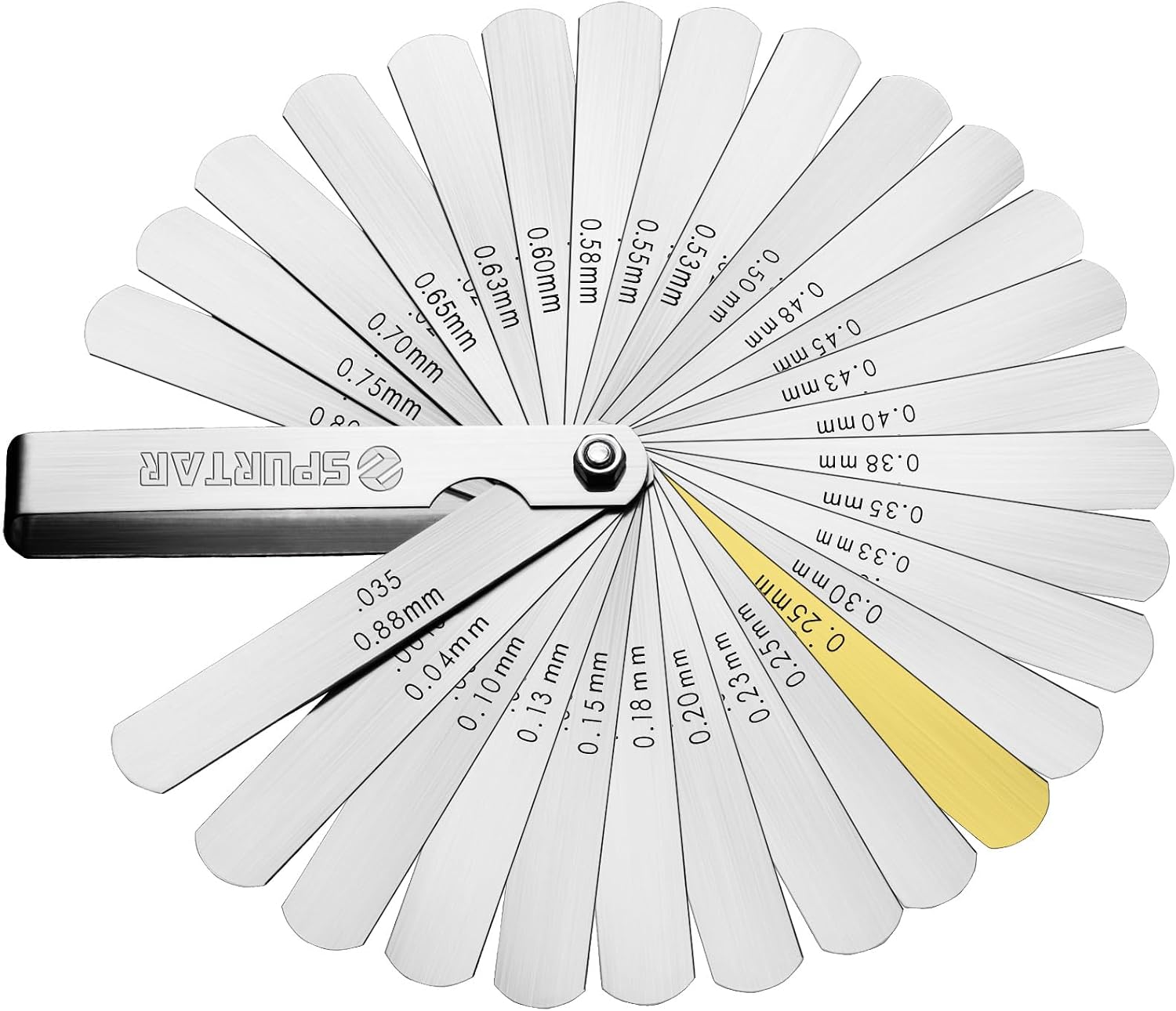
Fret at the third fret again and slide feeler blades into the gap over the first fret until one just drags. That blade thickness is your clearance. A metric set covering 0.04mm to 0.88mm does everything a guitar needs, and you will use it again for relief and action. A best rated feeler gauge set costs under a tenner and its blades slide under a string that is barely lifted. Write the six numbers down.
Which cause of guitar buzzing at first fret have you got?
Match what you found to the table.
| What you found | Most likely cause | Confirm it | Fix |
|---|---|---|---|
| Open string buzzes, stops when fretted, no daylight at fret 1 | Slot cut or worn too low | Gap test, feeler gauge | Build up slot or replace nut |
| Open string buzzes, string moves side to side in the slot | Slot too wide for the gauge | Wiggle the string at the nut | Replace nut, or use correct gauge strings |
| Buzz on open strings, nut tilted toward the headstock | Nut lifting or tipping | Fingernail along the nut to wood joint | Re-glue, or replace nut |
| Buzz only when fretting at the first fret, open strings clean | Second fret high | Straight edge across frets 1 to 3 | Fret level and crown |
| Buzz worse in winter, all strings, action feels low | Dry air, neck has moved | Hygrometer below 40% | Humidify, then re-measure |
| Buzz on one string, mid neck, nut measures fine | Relief, or a high fret further up | Capo test and relief measurement | Truss rod or fret work |
The five causes, ranked by likelihood
1. The slot is cut too low
The common one by a distance. Factory nuts on budget guitars are often cut low to feel easy in the shop, and nuts wear. Every bend and string change drags the string through the slot, and bone, plastic and TUSQ all give up material. Buzz since day one points to the factory cut. Buzz that crept in over months points to wear plus a gauge change.
2. The slot is too wide for the string
Slots are cut for a gauge. Drop from 11 to 9 and the strings sit loose in slots sized for something heavier, rattling in the bottom rather than seating in it, and the sound is thinner than a rattle. Fret at the third fret, then try to move the string sideways in the slot. More than a whisker of movement means the slot is wrong for the string, and raising the floor cannot fix a slot that is too wide. That is a new nut.
3. The nut has tipped forward or lifted
Nuts are held by string tension and two small dots of glue. If the glue has failed, or the slot in the neck is slightly deep so the nut rocks, it leans toward the headstock and the effective height at the front edge drops. Run a fingernail along the nut to fretboard joint. A lip or a gap you can feel means it has moved. Loose is a ten minute re-glue. Cracked through a slot means replace it.
4. A high second fret, which is not a nut problem at all
This is the misdiagnosis that costs people money. If your open strings are clean but fretting a note at the first fret buzzes, the string is hitting the second fret. The nut is fine, and raising it makes the guitar harder to play while leaving the buzz untouched. Lay a straight edge across frets one, two and three. Any rocking means a high fret. A credit card is a rough check, a fret rocker is better, and the fix is a level and crown. Wood moves, frets do not.
5. Back-bow, a tight capo or a worn string
A neck with too little relief plays buzzy everywhere and the first few frets feel it first. Wet weather, an over-tightened rod or a guitar out of a cold van will all do it. The check is in how to set up a guitar. A worn string with a flat spot can also buzz in the slot even when everything measures right, so if the buzz arrived with new strings, change the string first.
How much clearance should a nut slot have?
Repair shops converge on similar ranges. These are the gaps between the underside of the string and the top of the first fret, with the string fretted at the third.
| String | Electric clearance | Acoustic clearance | Open string height over fret 1 |
|---|---|---|---|
| High E (0.009 to 0.010) | 0.10 to 0.15mm | 0.13 to 0.18mm | 0.25 to 0.30mm |
| B | 0.13 to 0.18mm | 0.15 to 0.20mm | 0.30 to 0.35mm |
| G | 0.15 to 0.20mm | 0.18 to 0.23mm | 0.35 to 0.40mm |
| D | 0.18 to 0.23mm | 0.20 to 0.25mm | 0.40 to 0.45mm |
| A | 0.20 to 0.25mm | 0.23 to 0.28mm | 0.45 to 0.50mm |
| Low E (0.046) | 0.25 to 0.30mm | 0.28 to 0.33mm | 0.50 to 0.60mm |
Bass strings need more room than treble strings, so a nut cut dead level across all six will buzz on the low E first. And the numbers are small, which is why a feeler gauge beats guesswork.
Slot depth is separate. The slot should be deep enough that roughly half the string diameter sits below the top of the nut, and no more. Too deep buries and muffles the string. Too shallow leaves it perched on top like a fence rail, which is a tuning problem rather than a buzz, and a best rated nut lubricant helps there but will not fix a shallow slot. A best rated string action gauge reads relief, action and nut clearance off the same card.
Also check for sharp fret ends while the strings are slack. A dry UK winter shrinks the fretboard and pushes them out, and they buzz against a string near the edge. If the buzz is on the outside strings and the ends feel sharp, read guitar fret sprout before blaming the nut.
Fixing it, cheapest first
Work down the list. Do not start at the bottom, because the expensive fix is rarely the one you need.
Fix 1: build the slot floor up with superglue and bicarbonate of soda
The classic bench repair, and it works when a slot is only slightly low, say 0.05mm to 0.15mm. Bicarbonate plus cyanoacrylate sets hard in seconds and files like dense plastic, close enough to bone to be invisible.
- Slacken the string off the tuner, lift it clear, and mask the fretboard either side of the nut with low-tack tape.
- Clean the slot with a cotton bud dipped in naphtha or isopropyl alcohol and let it dry. Glue will not stick to finger grease.
- Put one small drop of medium cyanoacrylate in the slot with a cocktail stick. Not thin glue, it runs.
- Tap a pinch of bicarbonate into the drop. It fizzes and goes hard almost immediately.
- Leave it fifteen minutes, then file the slot back to depth with a gauged nut file, checking with the feeler gauge every few strokes.
- Restring, tune to pitch, check the open string again.
Add less bicarbonate than you think and file slowly. At 0.3mm down you will be filing forever, and a new nut is quicker.
Fix 2: shim the nut up
A shim raises the whole nut, so it suits a nut that is uniformly low, which is what you get when someone has sanded the bottom. Cut it from 0.25mm brass sheet, a business card or hardwood veneer, covering the full footprint, because a partial shim makes the nut rock.
Score the line where nut meets finish with a sharp blade so you do not tear lacquer, then tap the nut out toward the headstock with a block of wood. Scrape off old glue, fit the shim, glue the nut back with two small dots and measure again. Shims are reversible, and it is what a shop would do to raise a nut without making a new one.
Fix 3: fit a pre-slotted replacement nut
The sensible fix for a nut badly low, cracked, or too wide in the slots. The slots come roughed in at roughly the right depth, so fitting one is a sanding and measuring job rather than a cutting job.
For a Strat the standard part is a 42mm pre-slotted nut in TUSQ, a self-lubricating synthetic that behaves better than the plastic Fender used in the 1990s and needs less looking after than bone. A best rated pre-slotted TUSQ nut is about thirteen pounds. Epiphone and Gibson-style guitars take a different width and radius, classicals another again, so measure first. Width, thickness and fretboard radius are the three numbers that matter. Score the finish, tap the old nut out toward the headstock, clean the slot to bare wood, then sand the new nut’s bottom flat on 240 then 400 grit until the height matches. Fit it dry, string to pitch, check the clearance, and only then glue it with two small dots.
Fix 4: have a new nut cut from a blank
The right answer for a valuable guitar, a cracked slot, or unusual spacing. A luthier cuts the slots to your gauge with gauged files, so each string sits at exactly the depth and width it needs.
Doing it yourself needs files matched to your gauge, not needle files, because a slot 0.05mm too wide rattles and one too tight pinches the string and ruins tuning. A best rated gauged nut file set sized for 10 to 46 strings covers the common electric gauges. Cutting from a blank is slow: rough to width, sand flat, fit, mark positions, then creep up on depth one string at a time. Expect an evening the first time.
What each fix costs in the UK
Shop rates vary by region and the south east sits at the top of every range. These are typical 2026 figures, not a quote.
| Job | Typical cost | Time | When it is the right call |
|---|---|---|---|
| Feeler gauge set, do it yourself | £5 to £10 | Ten minutes | Always, before anything else |
| Superglue and bicarbonate repair | £5 in materials | 30 minutes plus curing | Slot 0.05 to 0.15mm low |
| Shim under the nut | £0 to £10 | 30 minutes | Nut uniformly low, or a stopgap |
| Pre-slotted nut, fitted yourself | £13 to £25 | One to two hours | Slot badly low, cracked, or too wide |
| Pre-slotted nut, fitted by a shop | £35 to £55 | Same day | You do not want to sand and measure |
| New nut cut from a blank | £55 to £90 | Two to five days | Valuable guitar, odd spacing, cracked |
| Full setup including nut check | £45 to £75 | Two to five days | Action and tuning also feel wrong |
| Fret level and crown | £70 to £120 | Three to seven days | The real fault is a high second fret |
| Full refret | £180 to £320 | One to three weeks | Frets worn through, not a buzz fix |
A replacement nut usually costs less than a fret level and far less than a refret. If a shop quotes a refret for a first fret buzz without measuring the nut, get a second opinion.
When to stop and take it to a technician
Stop if the nut is cracked through a slot, or if the slot you need to fix is the low E and the nut is already at its lowest sensible height, because cutting the others to match makes the guitar harder to play. Stop if you have filed a slot too deep, since every stroke makes it worse, or if the buzz moves around as you play. On a guitar worth more than a few hundred pounds, a luthier’s £60 is cheap insurance.
If the buzz is electrical rather than mechanical, the diagnosis is completely different. Start with why is my guitar buzzing, which separates string buzz from earth hum in one paragraph.
Frequently asked questions
Why is my guitar buzzing at the first fret only?
Because that string’s nut slot is cut or worn too low, so the open string rests on the first fret. Fret at the third fret and look for a gap over the first. No gap means the slot is low. A buzz that only appears when you fret a note is a high second fret.
Is a little fret buzz at the first fret acceptable?
No. Buzz on an open string is a fault, and it gets worse as the slot wears. A touch of buzz when you hit a fretted note hard is normal on a low action. Buzz you can hear through an amp is not.
Can I fix it without files?
Sometimes. If the slot is a whisker low, superglue and bicarbonate will get you playing. If a slot needs lowering you need a gauged file, because a needle file cuts a V and a V rattles.
Will raising the action at the bridge fix a first fret buzz?
No. Bridge and saddle height change the action further up the neck and barely touch the first fret, because the string is anchored at the nut. If adjusting the bridge helps, you have a different problem.
Should I adjust the truss rod for this?
No. Relief has least effect at the ends of the neck and most in the middle. Tightening the rod to chase a first fret buzz usually produces a back-bow and a new set of problems further up.
Why did this start after I changed string gauge?
Lighter strings sit lower in a slot cut for heavier ones, and they rattle sideways in a slot that is too wide. If you have gone from 11s to 9s, expect a new nut or a return to the old gauge.
Why does my guitar only buzz at the first fret in winter?
Dry air shrinks the fretboard and neck, changing both relief and nut height, and central heating drops indoor humidity below 40%. Check with a hygrometer, humidify, and re-measure after a week instead of filing.
How do I know if it is the nut or a high fret?
Capo the first fret. If the buzz disappears it is the nut. If it stays or moves, it is a fret or the relief. Repair shops use that test as the first step because it is reliable.
How much does a new nut cost fitted in the UK?
A pre-slotted nut fitted by a shop is typically £35 to £55 in 2026. A nut cut from a blank by a luthier is £55 to £90. Fitting one yourself costs £13 to £25 for the part.
Related guides
- Why is my guitar buzzing: the full diagnosis, mechanical and electrical.
- Guitar action too high: when the problem is the other way round.
- How to set up a guitar: relief, action and intonation in the right order.
- Guitar fret sprout: why fret ends move in a UK winter.
- Guitar tuning pegs loose: the other end of the string, and the other common rattle.
- Why do guitar strings keep breaking: if the string is failing as well as buzzing.
- What is my guitar worth: check sold prices before spending money on a repair.
As an Amazon Associate, I earn from qualifying purchases. Links on this page are affiliate links, marked with rel=”sponsored”.