
If you are asking why do guitar strings keep breaking, the honest answer is that the string is almost never the problem. Strings are the strongest part of the instrument in the direction they are loaded, and a fresh set will happily sit at pitch for months. When one lets go, it is usually because something on the guitar has been cutting into it at the same point, thousands of times, until the metal gave up. A string that breaks once is bad luck. A string that breaks in the same place three times is telling you exactly where to look, and you can find it with a cotton bud and two minutes.
This guide is about finding that place. It covers the saddle, the nut, the tuning posts, the frets, the pick, the gauge, the weather, and the two mistakes people make when they fit a new set. There are UK prices for the fixes, a routine to run every time you restring, and the point at which you should pay a technician rather than keep buying strings.
The first thing to do: work out where it broke
Do not throw the broken string away. Fish it out of the bin and lay it along the guitar, ball end where it belongs at the bridge, and see where the break sits. That single measurement narrows the fault down to one or two components.
- Within a couple of centimetres of the ball end. The saddle, the bridge plate or the tremolo block.
- Just in front of the nut, so the broken end is only a few centimetres long. The nut slot, the string tree or the angle the string leaves the nut at.
- At the tuning post, with the coiled section still attached. A sharp edge inside the post hole, or the way it was wrapped.
- Halfway along, over the frets. Fret wear, a sharp fret end, corrosion, or the pick.
- Anywhere, but only at the point you bend to. A pinch point at the nut that only grabs when tension rises.
If you cannot tell from the string, look at the guitar side instead. Run a cotton bud around the saddle where each string sits, through the nut slots, and around the inside of each tuning post hole. Cotton fibres catch on a burr that your finger will slide straight past. If you have a phone with a macro mode, photograph the contact points and zoom in. A burr you cannot feel is obvious at four times magnification.
Why do guitar strings keep breaking at the bridge?
The bridge is the most common site by a long way, and the reason is simple. Every string bends over the saddle at a sharp angle under full tension, and it moves across that point every time you bend, use the tremolo or tune. If the saddle has a burr, a groove or a sharp lip, the string is being sawn through from the moment it goes on.
On a tune o matic or similar bridge. Look at the top of each saddle where the string passes. New saddles often arrive with a sharp crease rather than a smooth curve, and the plating can flake. Run a fingernail across it. If it catches, fold a piece of 800 or 1000 grit wet and dry around the old string and work it through the saddle slot in the direction the string travels, just enough to break the edge. A set of fine needle files costs less than a couple of sets of strings and lasts forever. Take off the minimum, because lowering the contact point changes the break angle.
On a vintage style Fender bridge. The pressed steel saddles have a groove and the height screws sit underneath. A saddle that has slipped sideways so the string runs against the edge of the groove will cut a string fast. Check the string sits centred in its groove with the saddle straight.
On a guitar with a tremolo. Follow the string through the block. The hole in the inertia block, and the point where the string exits at the back plate, both develop burrs, especially if the block has been used with a heavier gauge that wore the holes oval. A burr inside the block is easy to miss because you cannot see it without slackening the string right off.
On a Telecaster or hardtail with ferrules. The string passes through the body to a ferrule at the back. A sharp ferrule edge or a bridge plate hole that has worn will cut the string right at the ball end. Check by running a new string through the hole with the guitar unstrung and feeling for a catch.
Some players fit saddles with a smoother, self lubricating contact point and simply stop having the problem. If your bridge has already eaten two sets, that is cheaper than another four sets of strings and a re set up.
Why do guitar strings keep breaking at the nut?
A nut slot that is too tight for the gauge is a slow guillotine. The string sits in a slot cut for a lighter set, the slot grips it, and all the movement from tuning and bending happens at the point where the string leaves the slot. Wound strings suffer most because the winding catches on the edge of the slot and starts to unwind, and a plain steel string will eventually snap where it has been work hardened.
Three things cause it.
- The slot is too narrow. Someone fitted a heavier set, or the guitar was set up for 9s and now runs 11s. The slot needs widening with a dedicated nut file, not with sandpaper folded over, and it needs to stay rounded at the bottom.
- The slot is full of dirt and old graphite. Grime and dried lubricant pack into the slot and turn it into sandpaper. Scrape it out with the corner of a business card or a soft toothbrush, then clean the slot out fully.
- The back edge of the nut is sharp. The string should leave the nut on a gentle ramp. If the nut was cut flat at the back, the string bends over a knife edge instead of a curve.
A best rated nut lubricant is worth having in the case. A tiny amount in each slot reduces friction so the string slides instead of binding, which keeps tuning stable and takes the load off the contact point. It is not a fix for a slot that is genuinely too tight, and no lubricant will save a nut with a sharp back edge, but it solves the everyday binding that causes most of the creaking, pinging and premature wear. Graphite from a soft pencil does the same job in an emergency.
String trees and retainer bars are the other suspect up here. The D and G strings on a Stratocaster pass under a small bar that pulls them down to the post. That bar is a second contact point, it often has a burr from the string sawing against it, and it is directly above the nut so the break looks like a nut problem. Raise it slightly, or replace it with a smooth roller type, and check the string is not sitting in a groove cut by the previous set.
Why do guitar strings keep breaking at the tuning post?
Breakage at the post is nearly always about the hole or the wrap.
The hole through the post can have a sharp edge from the drilling, and that edge sits exactly where the string bends as it comes round. Work an old wound string through the hole in a circular motion to knock the edge off, or use a fine file. A cotton bud through the hole will tell you if there is a burr in there.
Then there is the wrapping technique. Two to three clean wraps around the post, each one sitting below the last, with the string passing through the hole once and locking itself under the wraps, is what you want. Five or six wraps stacked on top of each other means the string is bearing on itself and on the edge of the hole rather than sitting flat. Wraps that cross each other create a high pressure point that snaps plain strings. If you fit locking tuners, the opposite applies, because they only need half a turn and extra wraps defeat the point.
There is one more failure worth knowing about, and it is the one that catches people out. A string that arrives kinked from the packet because it was coiled too tightly will often break at that kink within a day or two, usually near the post. If a brand new string snaps with almost no playing, look at whether it broke at a kink rather than at a contact point.
Why do guitar strings break in the middle, over the frets?
Breakage halfway along points at the frets, and there are two different faults.
Worn frets. Nickel silver frets develop divots under the strings, and the edge of a divot becomes a sharp lip. Bending a string across that lip is like dragging it over a chisel. If you can feel a notch with a fingernail under the B or G string around the second to seventh fret, that is your culprit. A fret level and crown is the fix, and in the UK that usually runs £80 to £150 depending on the number of frets and whether the board needs work first. Left alone, worn frets also cause the buzzing and tuning problems covered in why is my guitar buzzing.
A sharp fret end or a burr on one fret. Less common but easier to find. Run a finger along each fret where the string sits and feel for a rough patch. A single rough fret can be dressed smooth in minutes by someone who knows what they are doing.
Then there is the pick. A thick, sharp, heavy pick played hard at the same spot wears a plain steel string from the top down, flattening it and creating a stress riser. If you break high E strings at the point where you pick, and the frets look fine, try a lighter or rounder pick for a month. It is free to test and it is a real cause, not a myth.
Finally, corrosion. Sweat is acidic, it stays in the winding, and a corroded string loses strength before it loses tone. Players with particularly corrosive sweat can kill a set in a fortnight. Wiping the strings down after every session, and using a string cleaner now and then, makes a measurable difference. So does washing your hands before you play, which sounds fussy until you see what comes off a set that has been played for a month.
Why is it always the same string?
If the same string breaks in the same place repeatedly, stop buying strings and find the fault. Different strings breaking in random places is a different problem, usually age or technique.
- High E on a Stratocaster. The saddle, the string tree or a sharp post. Almost always the saddle.
- G string on an acoustic. The plain third is the thinnest string taking a full bend, and it is the first to go when the saddle has a groove.
- D string on a 12 string. The octave strings are thin and run at high tension. A worn saddle pinches them.
- Low E or A near the ball end. The saddle slot has worn into a groove, or the bridge pin hole is sharp.
- Any string at the 12th to 15th fret on a guitar with a hump. The neck angle is concentrating pressure on one spot.
The pattern matters more than the individual break. A luthier will diagnose in five minutes what takes you a month of guessing, and a saddle dress is cheap.
Do old strings break more than new ones?
Yes, and the difference is bigger than most people expect. A string is under constant tension and constant flexing, so it work hardens, and corrosion eats into the thinner sections first. A set that has been on for six months is measurably weaker than the same set on day one, even if it still holds tune.
The rule of thumb that holds up in practice is to change electric strings every six to eight weeks of regular playing, and acoustic strings every four to six weeks, sooner if you play a lot or sweat heavily. Coated acoustic strings last longer but they still fatigue. If a string breaks while you are simply tuning up, with no playing involved, that is fatigue rather than a mechanical fault, and it means the set was past its best.
Cleaning the strings and the fretboard well between changes slows the process down. Our guide to how to clean a guitar fretboard covers the board, and the technique is the same idea for strings: get the sweat and skin off before it eats in.
Why strings start snapping in November
There is a seasonal pattern to breakage in the UK, and it is not your imagination. Central heating comes on, indoor humidity drops from around 50 percent to 25 or 30 percent, and the guitar dries out. The fingerboard and the neck shrink slightly, which changes the relief and lowers the action, and more importantly the nut slots and saddle grooves tighten their grip on the strings as the wood and the metal around them move. A guitar that was perfectly set up in September can be pinching its strings by December.
The same dry air causes fret ends to creep out past the edge of the board, which is a sharp edge right where your hand goes, and it causes acoustic tops to sink or crack. A best rated guitar humidifier in the soundhole, or a room humidifier, keeps the guitar at the 45 to 55 percent it wants. The full options are in our guide to the best guitar humidifier, and if you store the guitar in a case over winter, the rules in how to store a guitar matter as much as the humidifier itself.
If your strings only ever break between November and March, treat it as a humidity problem that shows up as a string problem.
Gauge, tuning and tension
A string breaks when the tension on it exceeds what it can take, and tension is set by three things: the gauge, the pitch and the scale length.
Going up a gauge raises tension across the whole set. A set of 10 to 46 in standard tuning on a 25.5 inch scale puts roughly 100 pounds of total pull on the neck, and the high E alone sits around 16 pounds. Move to 11 to 49 and you have added about 15 percent, which is why a guitar set up for 9s will feel tight and may start breaking strings when you fit 11s without touching the nut slots.
Tuning up raises tension fast. If you play in open E or open A, or you tune the whole guitar up a semitone, you are asking a standard set to do something it was not designed for. Use a set intended for the tuning, or drop the gauge. Standard sets are designed for standard pitch, and the further you get from it the more often something lets go.
Drop tunings go the other way and lower tension, which is safe for the string but changes the set up. What breaks strings in drop D is not the tuning, it is the slackening and retuning, which works the string at the nut and the post.
One more tension trap: capos. A capo clamped hard enough to hold the low strings will flatten the wound strings under it, and a flattened spot becomes the break point. Use the minimum pressure that gives a clean note, and put the capo just behind the fret rather than in the middle of it.
Acoustic guitars, 12 strings and nylon
Acoustic breakage usually happens at the saddle or the bridge pin, because that is where the string makes its sharpest turn. Check three things.
- The saddle has a groove. A deep groove pinches the string and creates a stress point. Saddles are cheap to replace, and a bone saddle is an upgrade anyway.
- The bridge pin is sharp or the slot is tight. The string should sit in the pin’s slot without being crushed. If the pin is plastic and old, it may have cracked or deformed.
- The break angle is too steep. A tall saddle with the pins close behind it makes the string bend sharply at the pin. Some guitars need the pin holes reamed slightly or the saddle lowered.
On a 12 string, expect the octave G to be the frequent casualty. It is the thinnest string on the guitar and it sits in the same crowded saddle as everything else. Check the saddle slot for that string specifically, and do not overtighten the octave strings when you fit them.
Nylon strings are a different animal. They do not corrode like steel, they degrade in sunlight, and they break at the tie block on the bridge or at the roller. A sharp edge on the tie block, or a string tied with too few or too many wraps, will cut through nylon quickly. Nylon also creeps for days after fitting, so it is normal to retune repeatedly, but it should not snap.
Fitting a new set without breaking one
A surprising number of breakages happen in the first ten minutes after a restring, and the cause is nearly always the fitting.
- Do not kink the string when you take it out of the packet. Uncoil it gently and keep the curve it came with.
- Feed it through the post hole before you bend it, then bend the short end round the post rather than bending the long section.
- Tune up to pitch from below. If you overshoot, slacken well past the note and come back up. Bringing a string down to pitch leaves the wraps loose on the post, and it will slip and creep.
- Stretch the string until it holds. Pull it gently away from the body at the twelfth fret, retune, repeat three or four times until it holds. This is what stops the string going flat after every bend, and it takes two minutes.
- Trim the tag end a few millimetres from the post, not flush, so it cannot catch your hand but does not leave a sharp hook.
A best rated string winder makes this much quicker and encourages you to do it neatly rather than rushing. If you want the full walk through for each type of guitar, our guides to how to change guitar strings and how to restring an electric guitar cover the order and the locking method.
What to do when one breaks mid gig
Slacken the remaining strings a little before you fit the new one, because the neck is now unbalanced and the tuning will drift once tension is back. Change the broken string, stretch it, tune it, then check the others. Never leave a broken end coiled loose in the case where it can scratch the finish.
If you break the same string at every gig, buy a spare set for that string position and keep it in the case pocket. Most players break one string type more than the others, and it is cheaper than carrying three full sets.
When to stop fiddling and pay someone
There is a line beyond which string breakage is a repair job rather than an adjustment.
- New nut needed because the slots are worn, too low or cut for a different gauge. Expect £40 to £80 fitted in the UK, more on a vintage instrument or one with a difficult nut material.
- Fret level and crown for worn frets. £80 to £150 is typical, and it transforms how the guitar plays as well as how long strings last.
- A refret if the frets are worn through to the board. £250 to £400, and worth it only on a guitar you intend to keep.
- Bridge or saddle work on an acoustic, which is usually quick and cheap to have done well.
A guitar that has been eating strings for a year is telling you that the setup has drifted. Our guide to how to set up a guitar covers the adjustments you can do yourself, and a guitar action that is too high article covers the symptom that usually arrives alongside it.
The short answer
Why do guitar strings keep breaking? Because a string breaks at its weakest point, and the weakest point is where the guitar has been cutting it. Measure where it broke, inspect that contact point with a cotton bud and a magnifier, and fix the metal rather than the string. Old strings, dry winter air, a gauge change and a sloppy fitting technique all make it worse, but the repeated break in the same place is always mechanical. Six strings and a five minute check on each contact point will cost less than a year of replacing sets.
Recommended gear
Everything here is what I would actually put in a case, not a list of everything on the market.
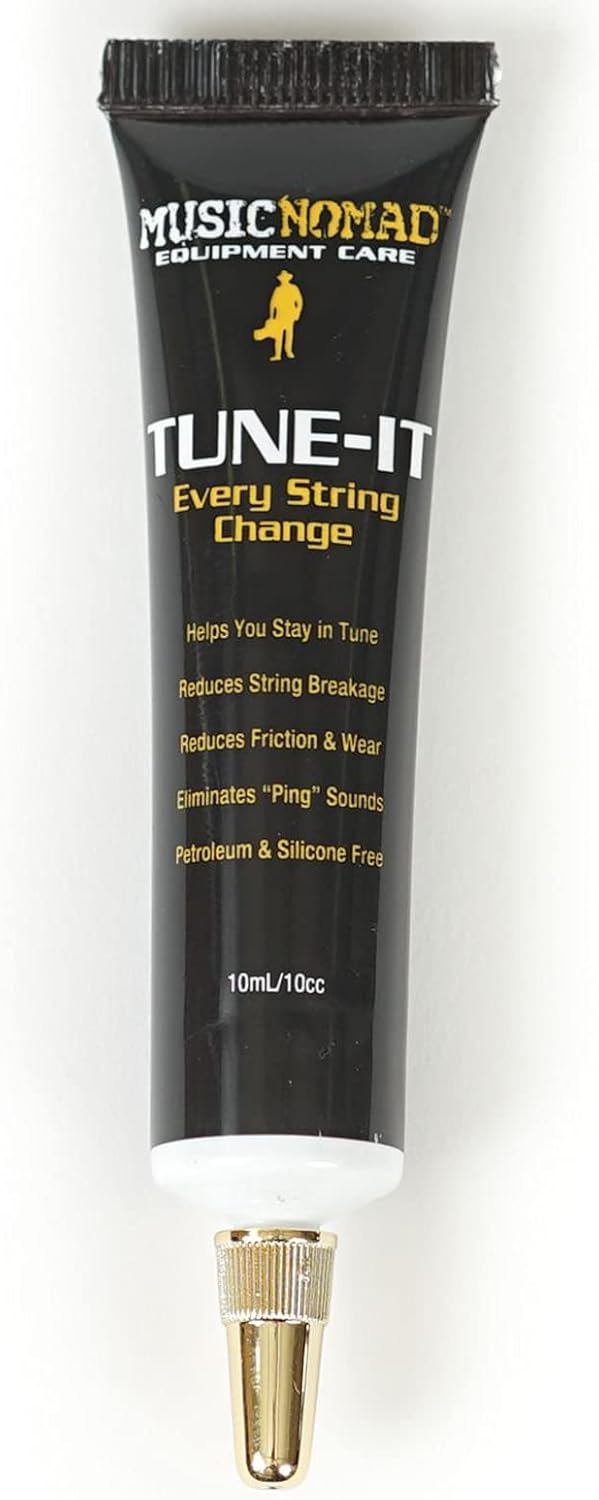
- MusicNomad TUNE-IT nut and saddle lubricant for the slots, which is the cheapest fix for binding and the tuning drift that comes with it.
- Ernie Ball Regular Slinky 10 to 46 for electrics, a set that behaves predictably and does not cost much to replace.
- Elixir 16052 phosphor bronze 12 to 53 for acoustics if you want a set to last through the winter without going dead in a month.
- Planet Waves Pro-Winder so restringing takes ten minutes and you do it neatly instead of putting it off.
- Snark SN5X clip on tuner because tuning up from below is impossible to do accurately by ear when the room has a drummer in it.
- D’Addario soundhole humidifier for the winter months, which is when most of the preventable breakage happens.
If you are weighing up whether a guitar is worth fixing at all, the compare guitars tool will show you what the model is fetching before you spend money on it.
FAQ
Why do my guitar strings keep breaking at the ball end?
The ball end sits against the bridge plate, the saddle or the tremolo block. A sharp edge at any of those points, or a saddle that has worn a groove, will cut the string right where it leaves the saddle. Run a cotton bud around the saddle contact point and through the tremolo block hole. If fibres catch, that is your answer.
Can old strings break just from sitting on the guitar?
Yes. Steel strings are under constant tension and they corrode slowly in the air, and the combination weakens them even if the guitar is never played. A guitar left strung for a year in a room with central heating will often break a string the first time it is tuned. Change them before they fail rather than after.
Why does my high E string keep breaking when I bend?
A bend pulls the string across the saddle and the nut under extra tension, so a burr at either point cuts it fast. If it breaks at the saddle, dress the saddle. If it breaks near the nut, the slot is pinching. If it breaks along the length you bend, look for a worn fret under that string.
Do expensive strings break less often?
Not in the way people hope. A premium string has better quality control and may resist corrosion longer, but no string survives a sharp saddle. If you are breaking strings at the same point, the money is better spent on a needle file and a saddle check than on a more expensive set.
Should I change all six strings when one breaks?
If the set is more than a few weeks old, yes. A single new string alongside five tired ones gives you uneven tone and tuning, and the others are close to failing anyway. If the set is fresh and one fails at a contact point, replace just that string after you have fixed the cause.
As an Amazon Associate, I earn from qualifying purchases. Links on this page are affiliate links, marked with rel=”sponsored”.