
Guitar fret sprout is what happens when the fretboard shrinks and the frets do not. As the wood dries in a heated house the board narrows across its width, the fret ends that were flush with the edge start to stand out, and the corners feel like a row of blades. It is cosmetic, not terminal, and you can fix it at home in about half an hour.
Key takeaways
- Fret sprout is a humidity problem, not a fret problem. The metal never grows, the wood shrinks.
- UK central heating takes a room from about 50% relative humidity down to 30% or below, which moves a 45mm board by 0.2 to 0.3mm.
- Get the humidity stable at 45 to 55%, wait a fortnight, then file the ends once. File before then and you will do it again next winter.
- A fret end file with a safe edge and two layers of masking tape will do the job. A rotary tool will ruin the board in one slip.
- Oil does not fix sprout. It slows water loss slightly and improves the look of the board, and that is all.
Some links on this page are affiliate links and I earn a small commission if you buy through them. It does not change what you pay.
What guitar fret sprout actually is
A fretboard is a separate slice of wood glued to the front of the neck, usually rosewood, ebony, or a maple cap over a maple neck. The frets are pressed into slots cut across the full width of that board. Nickel silver and stainless steel move with temperature, but they do not absorb water, so their length never changes with the weather.
Wood does. Every board holds a few percent of its weight in water, taken from the air around it. When the air dries the board gives water up and shrinks, and the shrinkage is not equal in all directions. Wood barely moves along the grain, which is why your neck does not get shorter in January. It moves a lot across the grain, which is the direction a fretboard is at its widest.
So the board narrows. The frets, held by a barbed tang that bites into the sides of the slot, stay exactly the same length. The ends that were level with the board edge now hang over it, and each one presents a square corner of nickel silver on a curved edge. That is the whole mechanism. Nothing has warped, nothing has broken, and the frets have not moved sideways.
Why it happens in a UK winter
Relative humidity is measured against the temperature of the air. Warm air holds far more water than cold air, so when cold outside air is drawn into a house and heated, its relative humidity falls even though the actual amount of water in it has not changed.
A damp November day might be 8C at 85% outside. Bring that air in, warm it to 21C and add nothing, and it sits at roughly 30%. That is the setup for fret sprout, and it is why the problem appears every October and disappears every April across the whole country.
Wood settles at a moisture content that balances with the air around it. At 50% relative humidity a rosewood board holds around 9% water, and at 30% it holds around 6.5%. Losing a quarter of its water moves it several tenths of a millimetre across the neck.
The two-minute test: fret sprout or something else
Run the pad of your finger along the edge of the board on the treble side, from the 5th fret to the 12th. Then do the same with the back of your fingernail, which is far more sensitive to a step. Then do the bass side.
Sprout feels like a series of tiny catches at regular intervals, one per fret, on both edges, worse as the board gets wider towards the 12th fret. A tissue dragged along the edge will catch and tear on the ends if your hands are too calloused to feel it, and raking light shows the proud ends as a row of silver tabs.
| What you find | What it usually is | What to do |
|---|---|---|
| Both edges sharp, worst around the 9th to 12th fret, no change in setup | Fret sprout from a dry board | Humidify for two weeks, then file the ends |
| Sharp ends on a guitar that arrived last week from a warehouse | Factory skipped the end dressing, board never dried to UK levels | Treat it as sprout, start humidifying now |
| One fret end sticks out much further than its neighbours | That fret has lifted in its slot | Glue and clamp it, do not file it back |
| A single note chokes near the edge, no sharp ends | High or uneven fret | Fret rocker first, then a level and crown |
| Sharp ends plus a sunken top and high action on an acoustic | Severe drying, the whole instrument has shrunk | Humidify first, reassess in a month |
| Plastic binding shrunk away from the fret ends on an older Gibson | Binding shrinkage, not sprout | Different job, and one for a technician |
How much does the board actually move?
The numbers are small, which is why people are surprised by how sharp the result feels. A typical electric neck is about 43mm wide at the nut and 52mm at the 12th fret. An acoustic is about 45mm and 56mm.
Rosewood and ebony shrink across the grain by roughly 0.15 to 0.2% for every one percent change in moisture content. Going from a humid summer at 9% down to a heated January at 6.5% is a change of two and a half points, so the board loses around 0.4 to 0.5% of its width. On a 52mm board that is 0.2 to 0.26mm, or about 0.1 to 0.13mm per edge.
A tenth of a millimetre sounds like nothing. Your fingertip feels a step of about 0.05mm and a human hair is about 0.07mm thick, so an end standing 0.1mm proud reads to your hand as a cut. In inches that is 0.004in.
| Room relative humidity | Board moisture content | What happens to the neck | Typical UK situation |
|---|---|---|---|
| 65% and above for weeks | About 12% | Board swells, action creeps up, mould risk in a gig bag | Unheated spare room in a wet autumn |
| 50 to 55% | About 9 to 9.5% | Stable, fret ends flush, tuning steady | Humidified room, or a mild damp day |
| 40 to 45% | About 8% | Fine short term, ends just starting to show | Mild winter day, heating low |
| 30 to 35% | About 6.5 to 7% | Ends proud by around 0.1mm per side, sharp to the hand | Centrally heated living room in January |
| Below 25% | About 5.5% | Real sprout, sunken top on acoustics, crack risk | Cold snap, heating full, no humidification |
The decision tree: humidify, file, or leave it
- It is cutting you or uncomfortable to play. Fix the humidity for two weeks, then file the ends. That is the main path in this article.
- You can feel it but it does not hurt. Get a hygrometer, get the room to 45 to 55% and reassess in a fortnight. Many necks come back flush on their own.
- It is a cheap guitar and it plays fine. Leave the frets and fix the humidity anyway. Dry wood is what cracks tops and lifts braces later, and that is a far bigger bill.
- You cannot control the humidity where it lives. Have a technician file the ends while the guitar is at its driest. The ends then sit slightly inside the edge when the board swells rather than coming back proud.
- The ends are sharp and the top is sinking. Stop. Humidify first and leave the files alone until the instrument has stabilised.
Fix 1: get the humidity right
You cannot manage what you cannot measure. A cheap digital best rated hygrometer like this TempPro costs less than a set of strings and tells you what the room is actually doing. Put it where the guitar lives, not in the hallway, and read it in the morning when the heating has been on all night. Aim for 45 to 55% and treat stability as more important than the exact figure.
For an acoustic the practical route is a case and a soundhole humidifier. A D’Addario soundhole humidifier dampened and wrung out, guitar in the case, lid shut, works in a way that a bowl of water in the room never does. For an electric, a gig bag with a humidifier pack or a small room humidifier is enough. There is more on the options in my guide to the best guitar humidifiers.
Two warnings. Do not overshoot, because weeks above 60% swell the top, raise the action and put mould in the case lining. And give it time, because ten to fourteen days at a steady humidity is the window before you decide whether the ends still need filing. If the guitar lives somewhere you cannot humidify, my guide to how to store a guitar covers the case, stand and wall hanger options.
Fix 2: file the fret ends flat
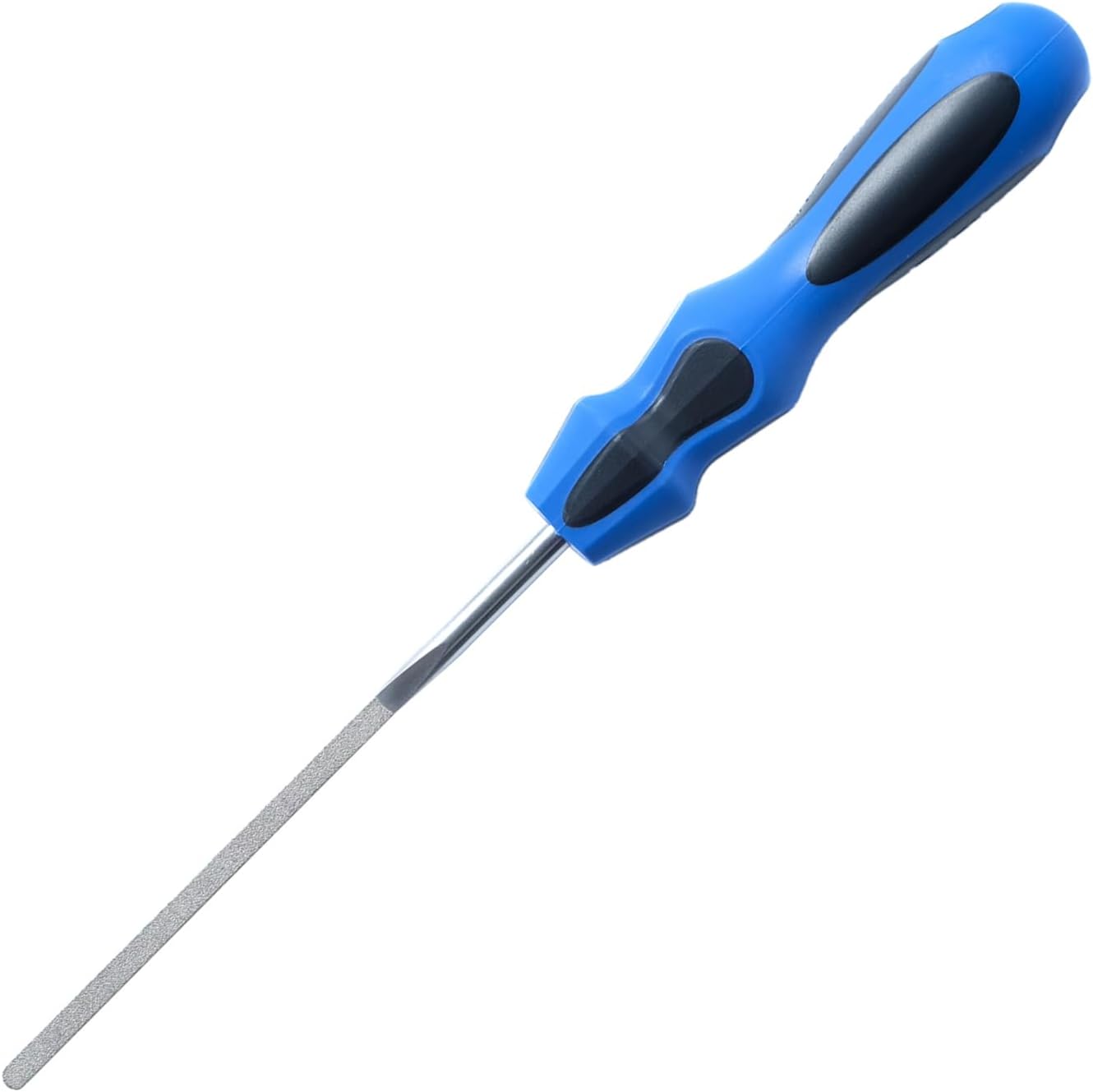
The tool is a fret end file, sometimes called an end dressing file or an E-file. What matters is that it cuts on one face and has a smooth safe edge, so the smooth side rides on the board while the cutting face takes the fret end. The MusicNomad MN830 diamond fret end file is the one I use, and it is the least likely of the cheap options to gouge a board.
- Support the neck. Lay the guitar flat with a folded towel under the neck so it cannot rock. A neck that moves mid-stroke is how people take a chunk out of a board.
- Tape the edge. Two layers of masking tape along the board edge, right up to the fret ends. Not optional on a bound board, good practice on any board.
- Match the bevel that is already there. Most fret ends sit at around 30 to 35 degrees from the board face. Hold the file at that angle and work along the existing bevel, a couple of light strokes at a time.
- Start around the 9th to 12th fret. That is where the board is widest and the sprout is worst, so your angle is settled before you reach the nut.
- Never file flat along the edge at 90 degrees. That squares off the bevel and leaves a corner sharper than the one you started with.
- Take the burr off. Once the ends sit level with the board, two passes at around 45 to 50 degrees rounds the corner without shortening the fret.
- Check as you go. Fingernail, then a tissue, then a look down the edge in raking light. Taking a little more off is easy, putting metal back is not.
- Clean out the dust. Wipe the slots with a cloth rather than blowing it out.
On a bound board, slow right down. The binding on a Les Paul or an Epiphone is plastic, it sits exactly where the file wants to go, and it cuts about five times faster than rosewood. If the ends are proud but not sharp, a fine diamond paddle worked lightly along the edge is far less risky for a first attempt.
Fix 3: polish the ends and oil the board
Filing leaves a fine scratch pattern on the end of each fret, and a scratched end feels rougher than the burr you removed. Work along the edge with 400 grit, then 600, then 1000, or use a best rated fret polishing set with fretboard guards, which keeps the abrasive off the wood. The guards matter, because 400 grit on rosewood leaves a light patch you cannot get rid of.
Then oil the board. A thin coat of D’Addario lemon oil, left five minutes, then buffed dry, darkens a dry board and slows water loss from the surface. It does not restore dimensional stability and it will not stop sprout on its own. Once or twice a year is plenty, and more than that softens the wood and lifts dirt out of the grain. My guide to lemon oil for guitar fretboards has the full method, and how to clean a guitar fretboard covers the order to do the two jobs in.
Five mistakes that make fret sprout worse
- Filing before the board has stabilised. File at 30% humidity and the board grows back out past the ends in April, leaving a ledge at every fret.
- Using a rotary tool. A Dremel takes a fret end off in a second and the board with it on the second it slips.
- Oiling instead of humidifying. Oil is a surface treatment. The water that moves a board is inside the wood, balancing with the air.
- Humidifying for a week a year. Cycling a board between 30% and 55% works the ends out a little further each winter.
- Filing the crown. Material coming off the top of a fret means the angle is wrong, and you are now doing a partial fret dress by accident.
What a luthier charges in the UK
Fret end dressing alone is a small job and most shops price it at bench rate. It is often folded into a fret dress if the frets are also worn, which is worth knowing before you ask for a quote.
| Job | Typical UK price, November 2026 | Where the figure comes from |
|---|---|---|
| Fret ends filed and polished only | About £30 to £60 | Shop bench rates, usually quoted as a fret end dress |
| Setup including fret dress and reprofile | £85 to £140 | Three separate UK workshop price lists |
| Partial refret, around six frets | From £75 | Guitar Technical Services price list |
| Glue a loose or lifted fret | From £35 | Guitar Technical Services price list |
| Full refret | £170 to £230 | Published UK price lists, standard board |
| New nut because the slots are cut too low | From £60 | Guitar Technical Services price list |
| Doing it yourself, once | £29 file plus £5 hygrometer | Amazon prices checked November 2026 |
One fret end file pays for itself against a single bench charge, and the job is half an hour on a first attempt. What you cannot buy is judgement about how much metal to take off.
When it is not fret sprout
A brand new guitar with sharp ends out of the box. That is not shrinkage, it is a factory that skipped the end dressing. It is common on budget instruments and on anything built in a humid factory in Indonesia, China or Vietnam, where the board was at 12% moisture content when it was built and has dried to 6% by the time it reaches a UK living room.
One fret standing proud, or a note choking. That is a fret problem, not humidity. A lifted fret needs glue and a clamp and a high fret needs levelling. Filing the end of a lifted fret makes it look neat and leaves the buzz exactly where it was. The guide to guitar buzzing walks through which symptom means which fault.
Sharp ends with a sunken top and high action on an acoustic. The whole instrument has dried out and the top has dropped. Humidify for a month before anyone touches the frets, because the geometry changes as the top comes back up. My article on guitar action that is too high covers that measurement, and the full setup guide has the order to adjust things in.
Shrunk binding on an older guitar. On 1960s and 1970s instruments the celluloid binding itself shrinks and leaves the fret ends exposed while the board has not moved. It looks similar and it is a technician’s job.
If you are shopping rather than repairing, sharp ends are one of the easiest things to spot on a used guitar and one of the clearest signs it has been stored dry. The guides on what to check on a used guitar and how much a guitar is worth in the UK cover the rest of the checklist, and you can pull recent sold prices for a specific model from the comparison tool.
Frequently asked questions
Is guitar fret sprout serious?
No. It is a cosmetic symptom of a dry fretboard and it does not damage the frets or the neck. The dryness behind it is worth taking seriously, because a guitar held below 30% relative humidity for a winter can crack a top or lift braces.
Will fret sprout go away on its own?
Partly. Get the humidity back to 45 to 55% and the board rehydrates and the ends come back in, so a mild case feels fine again. A bad case leaves the ends slightly proud even at normal humidity, and those need filing once.
Can I just file the fret ends straight away?
You can, but it is the wrong order. Filing while the board is at its driest means the ends sit inside the edge when the board swells in spring, leaving a ledge at every fret. Stabilise the humidity for two weeks first.
How much should fret end dressing cost in the UK?
Expect about £30 to £60 for the ends alone, and £85 to £140 if it is bundled with a fret dress and setup. A single fret end file costs around £29, so doing it yourself pays for the tool on the first guitar.
Does oiling the fretboard stop fret sprout?
No. Oil slows water loss from the surface for a few weeks and improves the look of a dry board, but the movement comes from water inside the wood balancing with the air. Humidity control is the only thing that stops it coming back.
Is fret sprout worse on rosewood or maple?
Rosewood and ebony show it most because they are a separate slice of wood glued to the neck and they move independently of it. One piece maple necks move less, though a maple cap board can still sprout. Bound boards feel worse because plastic sits right beside the fret end.
Can fret sprout cause fret buzz?
Not directly. An end sticking out over the edge does not change the height of the fret under the string. If you have buzz as well as sharp ends, the dryness has probably loosened a fret or changed the relief, and those need checking separately.
What humidity should a guitar be stored at?
45 to 55% relative humidity at normal room temperature, with 40 to 60% as the tolerable band. Below 30% for weeks is where sprout, sunken tops and cracks start, and above 65% for weeks brings swelling and mould.
Related guides
- Best guitar humidifier for holding an acoustic at a stable humidity
- How to store a guitar safely in a case, on a stand or on a wall
- Lemon oil for guitar fretboards and when not to use it
- Guitar action too high and how to measure it at the 12th fret
- How to set up a guitar in the right order
- Why is my guitar buzzing when the cause is not the frets
As an Amazon Associate, I earn from qualifying purchases. Links on this page are affiliate links, marked with rel="sponsored".